Ministry leadership today faces an unprecedented sustainability crisis. 42% of pastors in the United States have seriously considered leaving full-time ministry within the past year, according to recent Barna Group research. This statistic represents more than numbers it reveals exhausted shepherds overwhelmed by the competing demands of sermon preparation, pastoral care, administrative duties, and often secondary employment to make ends meet.
When pastoral burnout reaches critical levels, the ripple effects extend far beyond individual leaders. Churches lose their spiritual guides, congregations experience disrupted growth, and entire communities witness diminished gospel influence. The traditional Sunday-centered model, while foundational, has proven insufficient to address the complex discipleship and leadership development needs of modern believers.
Traditional church structures create natural limitations that hinder deep spiritual formation. Most congregation members interact with their pastor for merely one to two hours weekly during formal services. This compressed timeframe leaves little opportunity for the life-on-life apprenticeship model that Jesus employed with His twelve disciples a methodology that prioritized relationship-building, personalized instruction, and gradual leadership development.
Faith-based mentoring emerges as a powerful solution that bridges this gap, combining ancient discipleship principles with contemporary accessibility. Unlike conventional coaching approaches, faith-centered mentoring prioritizes holistic spiritual development over transactional skill transfer.
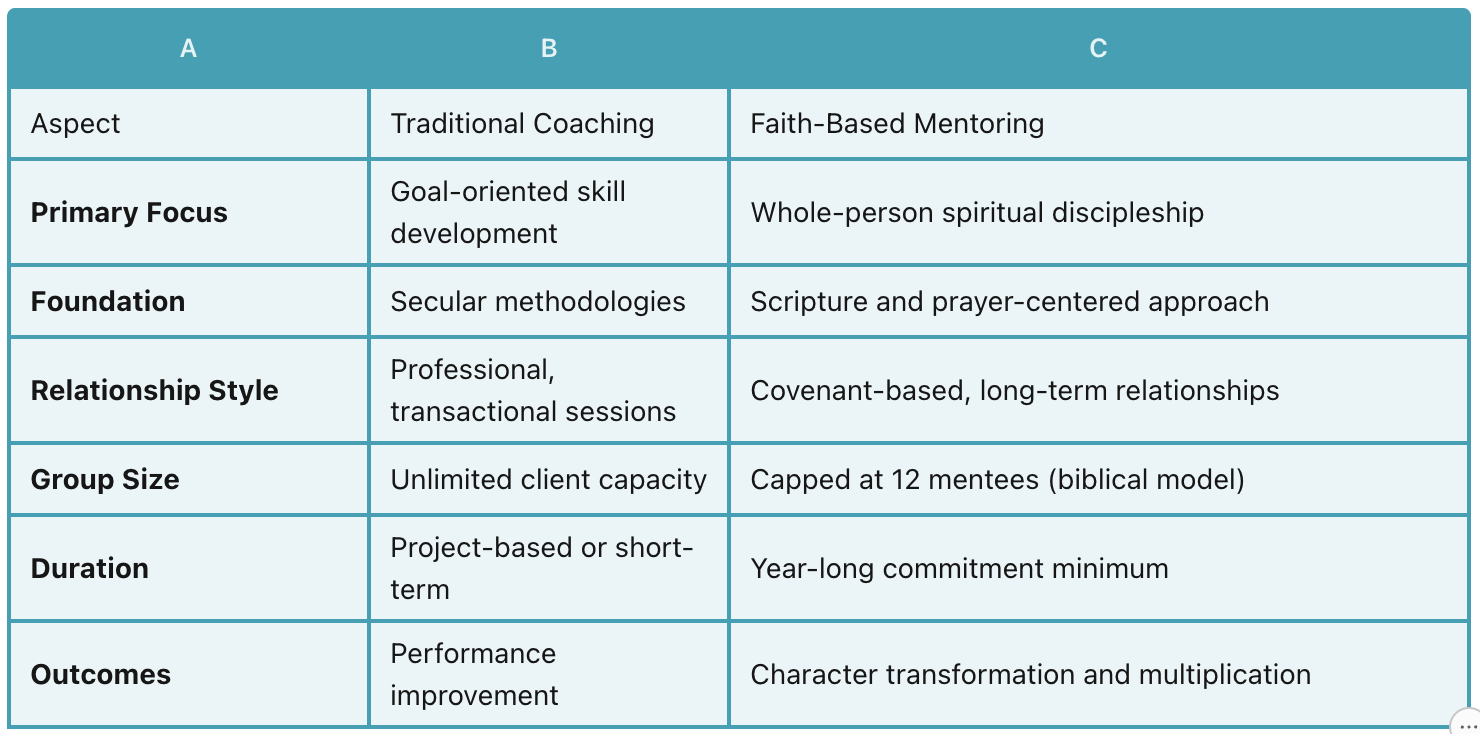
The twelve-person limit isn't arbitrary it mirrors Jesus' intentional approach to discipleship. This constraint enables mentors to cultivate genuine relationships, provide personalized accountability, and develop leaders who will eventually mentor others, creating a sustainable multiplication effect.
Faith-based mentoring transcends traditional pastoral boundaries, raising up Christian leaders in every sector of society:
Marketplace Ministry: Business executives and entrepreneurs mentor emerging professionals, integrating biblical ethics with excellence in commerce, finance, and entrepreneurship. These relationships produce leaders who view their careers as ministry platforms rather than merely income sources.
Creative Arts and Media: Faith-driven artists, writers, filmmakers, and musicians guide talented newcomers through the challenges of maintaining spiritual convictions while influencing secular culture. This mentoring creates content creators who produce redemptive art without compromising their faith foundation.
Global Pastoral Network: Ministers from Latin America, Africa, Asia, and other regions disciple believers in their native languages through virtual cohorts. This approach removes geographical barriers while honoring cultural contexts and local ministry needs.
The result is a kingdom ecosystem where vocational diversity strengthens unified biblical values, creating influence networks that extend far beyond church walls.
1. Identify Core Pain Points
Begin by diagnosing specific challenges your ministry seeks to address. Are you combating pastoral burnout? Addressing leadership pipeline gaps? Strengthening general spiritual formation? Clear problem identification ensures targeted solutions and measurable outcomes.
2. Establish Mentor Sustainability
Implement modest subscription fees (typically $100-200 monthly) to ensure mentor retention and program sustainability. This approach accomplishes multiple objectives: it provides supplemental income for ministry leaders, creates participant investment in the process, and generates resources for program expansion.
3. Maintain Biblical Group Limits
Cap mentoring cohorts at twelve participants maximum. This constraint prioritizes depth over breadth, enabling transformational relationships that produce multiplying disciples rather than passive consumers of spiritual content.
4. Commit to Long-Term Development
Require minimum one-year commitments from both mentors and mentees. Genuine character transformation and leadership development cannot occur through sporadic interactions—they demand consistent, patient investment over extended periods.
5. Leverage Purpose-Built Technology
Utilize integrated platforms that consolidate scheduling, resource sharing, group communication, payment processing, and progress tracking within a unified discipleship hub. This technological foundation eliminates administrative friction while maintaining relational focus.
Digital platforms function as contemporary versions of the Roman road system—infrastructure that accelerates gospel advancement across previously insurmountable barriers.
Global Accessibility: Virtual mentoring removes geographical constraints, enabling Brazilian pastors to disciple believers in Lagos, while American business leaders mentor entrepreneurs in Southeast Asia. Time zones become scheduling considerations rather than relationship prohibitions.
Scalable Stewardship: Robust platforms enable organizations to onboard hundreds of mentors without drowning in spreadsheet chaos or Zoom link confusion. Automated systems handle routine administration, freeing leaders to focus on relational investment and spiritual formation.
Data-Driven Discipleship: Comprehensive analytics track attendance patterns, engagement levels, and spiritual milestone progression. This information enables program refinement, mentor coaching, and outcome verification that strengthens both individual relationships and organizational effectiveness.
When selecting technology solutions for faith-based mentoring programs, prioritize platforms offering:
Effective faith-based mentoring programs generate measurable outcomes that extend beyond individual transformation:
Leadership Pipeline Development: Each twelve-person cohort ideally produces 2-4 future mentors, creating exponential leadership multiplication over 3-5 year periods.
Church Health Improvement: Pastors engaged in mentoring relationships report decreased burnout rates, increased ministry satisfaction, and enhanced leadership effectiveness.
Cross-Cultural Bridge Building: Global mentoring relationships foster international partnerships, missions support, and cultural understanding that strengthens worldwide church unity.
Vocational Ministry Expansion: Marketplace mentoring produces business leaders who integrate faith and work, creating testimony platforms and financial resources for kingdom advancement.
Mentor Recruitment: Begin with your most mature, relationally-skilled leaders rather than seeking perfect theological educators. Character and wisdom matter more than formal training.
Technology Adoption: Provide comprehensive training and ongoing technical support. Many effective mentors may struggle with digital platforms initially but adapt quickly with proper guidance.
Cultural Sensitivity: When developing global programs, involve local ministry leaders in curriculum development and relationship structure design to ensure cultural appropriateness.
Financial Sustainability: Balance accessibility with sustainability by offering scholarships for developing-world participants while maintaining revenue streams that support platform maintenance and expansion.
Faith-based mentoring represents more than a programmatic solution to pastoral burnout—it embodies a return to biblical discipleship methodologies enhanced by modern accessibility. As churches increasingly recognize the limitations of Sunday-only spiritual formation, mentoring platforms provide scalable infrastructure for life-transformation relationships.
The next decade will likely witness explosive growth in faith-based mentoring as organizations discover its effectiveness for leadership development, church health improvement, and global missions advancement. Early adopters who invest in robust platforms and proven methodologies will establish sustainable competitive advantages in ministry effectiveness and kingdom impact.
The path forward begins with a single decision: prioritizing relationships over programs, depth over breadth, and multiplication over mere addition. Faith-based mentoring platforms provide the infrastructure, but transformation occurs through covenant relationships between mature believers and emerging leaders.
Whether you're a church pastor seeking to address leadership development needs, a marketplace Christian desiring to integrate faith and business, or a ministry organization pursuing global impact, faith-based mentoring offers proven methodology for sustainable kingdom advancement.
The Great Commission wasn't intended for Sunday mornings alone—it demands life-on-life investment that produces disciples who make disciples. Digital platforms simply provide the tools to scale this ancient methodology across modern barriers.
Ready to transform lives while reducing administrative burden? Discover how Delenta's award-winning coaching platform streamlines every aspect of faith-based mentoring—from automated scheduling and group management to branded client portals and comprehensive analytics. Whether you're launching your first cohort or scaling to hundreds of mentors globally, Delenta provides the technological foundation that lets you focus on what matters most: transforming lives through discipleship.
Book your free Delenta demo today and take the first step toward building a sustainable faith-based mentoring network that combats pastoral burnout, multiplies kingdom leaders, and advances the Gospel worldwide.
What exactly is faith-based mentoring, and how does it differ from regular coaching?
Faith-based mentoring is a discipleship-centered approach that prioritizes whole-person spiritual development over transactional skill transfer. Unlike secular coaching, which focuses primarily on goal achievement and performance improvement, faith-based mentoring integrates Scripture, prayer, and biblical principles into every aspect of the relationship. The mentor serves as both a guide and spiritual shepherd, committed to the mentee's character transformation and kingdom impact rather than just professional advancement.
Why is the 12-person limit so important? Can't we help more people by accepting larger groups?
The twelve-person maximum isn't arbitrary it mirrors Jesus' intentional discipleship model with His twelve apostles. This constraint enables mentors to:
Larger groups inevitably become teaching sessions rather than mentoring relationships, diluting the transformational impact that occurs through life-on-life discipleship.
How long does a typical faith-based mentoring relationship last?
Most effective faith-based mentoring programs require a minimum one-year commitment from both mentors and mentees. Real character transformation and spiritual maturity cannot be rushed—they develop through consistent relationship and gradual growth over time. Many successful mentoring relationships extend beyond the initial year as deep bonds form and ongoing spiritual formation continues.
Faith-based mentoring addresses pastoral burnout through several key mechanisms:
Strategic pricing actually enhances program sustainability and accessibility. Here's why:
The goal is biblical stewardship creating systems that can serve more people over time rather than burning out resources quickly.
Focus on character over credentials when identifying potential mentors:
Remember: Jesus chose fishermen and tax collectors, not seminary graduates. Authentic life experience often trumps formal theological education in mentoring relationships.
While basic tools can work initially, purpose-built platforms provide significant advantages:
The administrative time saved and professional impression created often justify the investment within the first few months.
White-label capabilities are crucial for maintaining ministry authenticity and trust:
Generic platforms can feel impersonal and undermine the relational foundation essential to effective mentoring.
Data protection is paramount in faith-based mentoring relationships:
Never compromise on security when dealing with personal spiritual formation conversations and sensitive life information.
Cultural sensitivity requires intentional preparation and ongoing adaptation:
The gospel transcends culture, but effective communication requires cultural awareness and respect.
Yes, but with careful planning and clear expectations:
The key is majoring on the majors while minoring on the minors.
Faith-based mentoring transcends geographical and linguistic barriers, but certain factors enhance effectiveness:
Success depends more on local ministry relationships and technological infrastructure than specific languages or regions.
Effective measurement combines quantitative metrics with qualitative transformation indicators:
Quantitative Metrics:
Qualitative Indicators:
Long-term Outcomes:
Successful faith-based mentoring relationships typically demonstrate:
The ultimate success indicator is multiplication mentees who become mentors themselves.
Timeline expectations for faith-based mentoring programs:
3-6 Months: Initial relationship building, program structure establishment, early spiritual growth indicators
6-12 Months: Deeper spiritual formation, behavior changes, increased biblical knowledge and application
12-24 Months: Leadership development, ministry involvement, potential mentor identification and training
2+ Years: Multiplication effects, new mentor deployment, program expansion, measurable community impact
Character transformation requires patience avoid expecting overnight results while celebrating incremental progress along the journey.
Sustainable scholarship strategies include:
Aim for 20-30% scholarship capacity to maintain financial sustainability while serving those with limited resources.
Faith-based mentoring delivers measurable returns on investment:
Leadership Development ROI:
Church Health ROI:
Community Impact ROI:
The ultimate ROI is kingdom advancement transformed lives that transform others in perpetual multiplication cycles.
Don't let administrative complexity prevent you from multiplying disciples and addressing pastoral burnout in your ministry context. Delenta's award-winning platform provides everything you need to launch, manage, and scale a successful faith-based mentoring network.
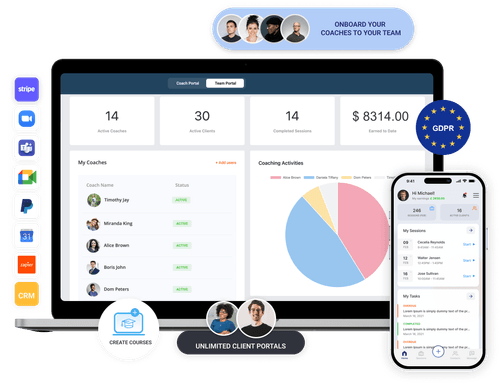
With automated scheduling, group management, branded client portals, comprehensive analytics, and robust security features, Delenta eliminates technological barriers so you can focus on what matters most: transforming lives through discipleship.
Book your free Delenta demo today and discover how easily you can build sustainable mentoring relationships that combat pastoral burnout, multiply kingdom leaders, and advance the Gospel globally. Your ministry's digital discipleship movement starts with a single conversation.
Ready to move from Sunday-only ministry to life-on-life transformation?
Schedule your personalized demonstration now and take the first step toward scalable spiritual formation that honors biblical discipleship principles while leveraging modern accessibility.


