.jpg)
A coaching program is not a training course, a leadership workshop, or a mentoring scheme. It is a structured series of one-on-one or group coaching engagements, designed to develop specific capabilities and produce measurable change in how people think, decide, and perform at work.
The word "business-aligned" is doing important work here. It means the program's goals are derived from your organisation's priorities, not from a generic competency framework someone found online. A sales team preparing for a market expansion needs a fundamentally different coaching design than a group of newly promoted managers learning to lead people for the first time.
When a coaching program is genuinely aligned to business context, it is far easier to measure, far easier to sustain sponsorship for, and far more likely to produce results that matter to the people funding it.
What this step does: Prevents the most common failure mode: building a program the business did not ask for and will not protect.
The most common reason coaching programs underdeliver is that the design starts before the alignment does. Someone in L&D or HR builds a program they think the business needs, presents it to senior leaders after the fact, and spends the next six months fighting for engagement.
Start with a structured stakeholder alignment process. Meet with the business leaders sponsoring the program, the managers of participants, and a sample of likely participants themselves. Ask three questions:
Document everything. A shared brief in a tool like Notion keeps all stakeholders anchored to the same version of the goal as the program evolves.
Stakeholder alignment is not a one-time meeting. Build a simple sponsor check-in cadence into the program calendar. Quarterly is a reasonable minimum for programs running six months or longer.
Step 1 verdict: Do this before opening a slide deck or writing a session outline. Programs that skip this step rarely survive past the first budget cycle.
What this step does: Translates stakeholder intent into outcomes you can defend with data.
Once you understand the business challenge, translate it into metrics before you build anything else. Vague outcomes like "improved leadership capability" will not sustain investment. Specific outcomes will.
Good success metrics for a coaching program might include:
Choose three to five metrics maximum. Trying to measure everything means you measure nothing well.
Pre-program baseline data is non-negotiable. You cannot demonstrate change without knowing where participants started. Collect it through structured self-assessments, manager observations, or existing performance data before the first session runs.
Use intake forms, built in Typeform or directly within your coaching management platform, to gather participant baseline data at enrollment. Delenta's Client Portal includes automated intake forms that trigger on first booking, so baseline data collection becomes part of the standard onboarding flow rather than a separate admin task.
Step 2 verdict: Three to five metrics with baseline data is the minimum viable measurement framework. Without it, you are running on faith, not evidence.
What this step does: Turns your goals into a repeatable session architecture that coaches and participants can actually follow.
Program design involves five decisions. Make them in this order.
Decision 1: Duration and cadence. Most effective business coaching programs run for six to twelve months. Shorter programs rarely produce durable behaviour change. A typical cadence is one 60-minute session every two to three weeks, with asynchronous check-ins or goal tracking between sessions.
Decision 2: Format: individual, group, or blended. Individual coaching produces deeper personal insight. Group coaching builds peer accountability and scales your investment further. Blended programs, which combine cohort group sessions with individual coaching, tend to produce the strongest combination of personal development and collective culture shift. The data on how coaches currently deliver their work reflects this reality: 87% of coaches use audio-video platforms to deliver their coaching services, while 73% continue with in-person coaching (ICF Global Coaching Study, 2025, p.42), suggesting that effective programs increasingly layer multiple delivery modes rather than committing to a single channel.
Decision 3: Session delivery platform. Most programs deliver sessions via video. Zoom, Google Meet, and Microsoft Teams all work well. If your organisation already runs on Microsoft infrastructure, Teams is the path of least resistance for participants. The platform decision matters less than consistency. Pick one and commit.
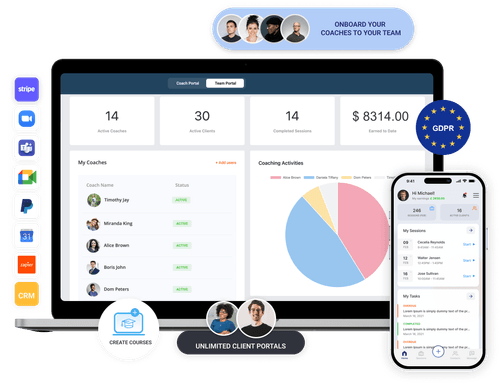
Decision 4: Between-session accountability. This is where most programs fail. Insights from coaching sessions evaporate quickly without structured follow-through. Build in goal-setting, action commitments, and progress check-ins between every session. Delenta's Client Portal gives each participant a dedicated space to track goals, complete assigned tasks, and receive nudges from their coach, which moves accountability from intention to infrastructure.
Decision 5: Resources and curriculum anchors. Decide what frameworks, tools, or readings will support participants between sessions. These should connect to the program's business context, not be generic leadership reading lists. Keep it focused. Three well-chosen resources are more valuable than a library nobody uses.
Step 3 verdict: Blended format with structured between-session accountability consistently outperforms single-mode designs. Build the accountability layer before the first session runs, not after completion rates start to slip.
What this step does: Reduces the biggest single variable in program outcomes: coach quality and fit.
Coach quality is the single biggest variable in program outcomes. A well-structured program with mediocre coaches will underperform. A slightly imperfect structure with excellent, well-matched coaches will often exceed expectations.
When recruiting coaches (external or internal) evaluate on four dimensions:
Relevant context experience. A coach who has worked extensively with senior executives may not be the right fit for a program designed for frontline managers. Ask for specific examples of work at the same organisational level and in comparable business contexts.
Coaching credentials and methodology. ICF accreditation is a useful baseline for professional standards. It is also an expectation that participants increasingly bring with them: 73% of coaches globally say that clients expect their coaches to be certified or credentialed (ICF Global Coaching Study, 2025, p.21). Beyond credentials, understand their coaching approach: directive or mentoring-heavy styles are often mismatched to transformational program goals.
Cultural fit. Coaches interact with your people at moments of genuine vulnerability. A coach who feels misaligned with your organisation's values, communication style, or expectations will create friction regardless of their technical skill.
Practical logistics. Timezone coverage, language capability, and availability across your program timeline are not administrative details. They determine whether sessions actually happen.
If you are running a multi-coach program, Delenta's intelligent coach-client matching filters by specialisation, language, timezone, and availability, removing a significant amount of manual coordination from the matching process and reducing the risk of poor fits at scale.
Step 4 verdict: For multi-coach programs, use a platform with structured matching capabilities. Manual matching at scale introduces risk that grows with every additional coach-participant pair you manage.
What this step does: Surfaces design flaws cheaply, generates evidence early, and creates internal advocates before the full rollout.
Resist the pressure to roll out company-wide immediately. A pilot cohort of 10 to 20 participants is almost always worth the three to four months it takes.
A pilot serves three purposes. It surfaces design flaws before they affect your full participant population. It generates the early evidence and testimonials that build internal momentum. And it creates a cohort of program alumni who become advocates inside the organisation when the broader rollout begins.
Structure your pilot with the same rigour you would apply to the full program. Use real participants, real coaches, and real success metrics. Document what you learn in a shared tool like Notion so the lessons feed directly into your revised design.
At the end of the pilot, run a structured retrospective with participants, coaches, and sponsors. Ask specifically what made sessions valuable, what created friction, and what they would change. Weight sponsor feedback heavily when it comes to reporting and evidence. Weight participant feedback heavily when it comes to session experience and engagement.
Step 5 verdict: A pilot is not optional: it is the cheapest insurance you can buy against a failed company-wide rollout. If internal pressure pushes you to skip it, use the pilot data from this section as your argument for doing it anyway.
What this step does: Replaces individual effort and goodwill with systems that keep the program running reliably at scale.
A coaching program is only as reliable as the systems running it. When programs rely on individual effort, spreadsheets, and email threads, they become fragile. One person leaving or falling behind creates a cascade of problems.
Before your full rollout, confirm these operational elements are in place:
Scheduling and session management. Participants need to book, reschedule, and receive reminders without involving a coordinator. Delenta's coaching scheduling software syncs with up to six calendars, handles timezone conversion automatically, and sends automated reminders, reducing no-shows significantly.
Progress and goal tracking. Coaches and program managers need visibility into whether participants are completing between-session work, progressing toward goals, and showing up. Real-time analytics dashboards remove the need for manual status updates.
Sponsor reporting. Corporate sponsors and HR leaders need regular evidence of engagement and progress. Delenta's shareable sponsor reports give stakeholders real-time access to engagement data and program metrics without requiring the program manager to manually compile reports before every check-in.
Communication channels. Decide how coaches, participants, and program managers will communicate outside of sessions. Keep it simple and consistent. Delenta includes built-in live chat for both one-on-one and group contexts, which reduces the need for external messaging tools.
If you are building on existing enterprise infrastructure, Zapier connects Delenta with your wider tool stack so data flows where it needs to go without manual transfer.
Step 6 verdict: Operational infrastructure is the difference between a program that survives personnel changes and one that collapses when the programme manager goes on leave. Build the systems before you need them.
What this step does: Prevents the most predictable point of program failure: the post-launch drop-off.
The three-month mark is where most coaching programs quietly begin to die. Initial enthusiasm fades, calendars fill up, and sessions start getting rescheduled rather than completed. Without structural support, completion rates collapse. This risk is compounded by a broader infrastructure gap in the profession: 53% of coaches are not using any digital coaching platform at all (ICF Global Coaching Study, 2025, p.5), which means programs relying on coaches to self-manage accountability between sessions are often doing so without the tools needed to sustain engagement.
Build momentum-sustaining structures into the program design from the beginning, not as a later patch.
Peer cohort connections. When participants have relationships with each other, not just with their coach, the program becomes a community rather than a series of appointments. Group check-ins, peer accountability pairings, and shared progress milestones all strengthen cohesion. Delenta's group coaching software supports cohort delivery natively, making it straightforward to run peer sessions alongside individual coaching tracks.
Visible progress markers. Delenta's Client Portal includes a points and awards system that makes participant progress visible and reinforces effort at the moments when motivation naturally dips.
Regular sponsor visibility. When sponsors can see real-time engagement data rather than waiting for a quarterly report, they stay connected to the program's momentum. This makes it far easier to protect the program's calendar priority when competing pressures emerge.
Celebration as structure. Build recognition into the timeline deliberately. Mid-program check-ins, completion recognitions, and alumni engagement all signal that the organisation takes the investment seriously. That signal matters to current and future participants.
Step 7 verdict: Momentum past 90 days is a design problem, not a motivation problem. If participants are disengaging, look first at whether peer cohesion structures and visible progress markers are actually in place, not at whether participants are sufficiently committed.
Tool Comparison: Platforms for Running Business Coaching Programs
[TABLE]
Tool Best For Starting Price Key Strength
Delenta Multi-coach programs, group cohorts, corporate sponsor reporting $29/month (Teams pricing on request) All-in-one platform with coach matching, group cohort management, white-label portals, and real-time sponsor reporting
CoachAccountable Structured individual coaching with strong goal tracking $20/month Goal accountability tools and worksheet library with clean client-facing interface
Notion Documenting program design, stakeholder briefs, pilot frameworks Free / $10 per member/month Flexible documentation and knowledge management for program planning
Typeform Intake forms, stakeholder surveys, post-session feedback Free / $25/month Intuitive form building with strong logic branching for pre-program data collection
Zapier Connecting coaching tools and automating data flows Free / $19.99/month Extensive integration library for stitching together mixed tool stacks
Zoom Video session delivery for coaching programs Free / $13.33/month per host Universal familiarity and reliability for video-based coaching sessions
[ENDTABLE]
Start with the business problem, not the coaching solution. Meet with sponsors and participants before you design anything. Define three to five measurable outcomes with baseline data collected before the first session runs. Build the coaching structure around those outcomes, and report against them on a regular cadence throughout the program. Programs that treat coaching as an activity disconnected from business metrics rarely survive long enough to prove their value, and rarely deserve to.
Begin with stakeholder alignment, then define your success metrics, then design the structure. Run a pilot with 10 to 20 participants before scaling company-wide. Build operational infrastructure, including scheduling, progress tracking, and sponsor reporting, into the design from the start rather than adding it later. Use a purpose-built coaching management platform to run the operational layer so the program is not dependent on individual effort to stay functional.
Six to twelve months in duration. One 60-minute session every two to three weeks. Blended formats combining individual coaching with group cohort sessions tend to outperform purely individual or purely group designs. Between-session accountability structures, including goal tracking and action commitments, are non-negotiable. Regular sponsor reporting rounds out the structure and keeps organisational support intact across the program lifecycle.
Run structured stakeholder interviews before the design phase. Ask sponsors what business challenge the program is addressing, what success looks like in measurable terms, and what obstacles to participation exist. Translate those answers into three to five specific, measurable outcomes. Build your program design, coach selection, and reporting cadence around those outcomes, not around a generic competency framework.
Yes. A pilot cohort of 10 to 20 participants lets you test the design, identify friction points, generate early evidence, and create internal advocates before a full rollout. Structure the pilot with the same rigour as the full program. Run a structured retrospective at the end with participants, coaches, and sponsors, and feed the findings directly into your revised design before scaling.
Evaluate coaches on four dimensions: relevant context experience at the same organisational level, coaching credentials and methodology (ICF accreditation is a practical baseline), cultural alignment with your organisation, and practical logistics including timezone, language, and availability. For multi-coach programs, use a platform with intelligent matching capabilities to filter candidates against these criteria efficiently rather than managing the process manually.
Build cohesion through peer relationships within participant cohorts. Group check-ins and accountability pairings are more effective than individual commitment alone. Make progress visible through milestones, recognition systems, and regular reporting. Give sponsors real-time access to engagement data so they stay connected to the program's momentum and continue protecting its place on the calendar. Treat celebration and recognition as structural program elements, not optional extras.
The most common failure causes are: starting design before stakeholder alignment is complete, setting vague outcomes that cannot be measured, selecting coaches without reference to business context, neglecting between-session accountability structures, and failing to build operational infrastructure that does not rely on individual effort. Programs also fail when sponsor visibility drops after the launch phase and the program loses its internal advocates, by which point recovery is rarely possible without a deliberate reset.
This article draws on the ICF 2025 Global Coaching Study as its primary data source for industry statistics. The ICF Global Coaching Study is the largest and most comprehensive survey of the coaching profession worldwide, conducted by the International Coaching Federation. The 2025 edition surveyed coach practitioners across all major global regions and covers practitioner demographics, revenue, technology adoption, client relationships, specialisation areas, and the outlook for the profession.
All statistics cited in this article are drawn directly from that study and attributed with their corresponding page references:
Where research flags in the original draft could not be matched to a statistic in the ICF index with sufficient relevance and precision, the surrounding prose was left to stand on its own evidence rather than supported by a mismatched data point.
Data verified against ICF 2025 Global Coaching Study. Article reviewed May 2026.
A coaching program that drives real business results is not an event. It is a system. It connects organisational priorities to individual development, anchors that development in measurable outcomes, and delivers it through a structure that can sustain itself past the initial enthusiasm.
The seven steps in this guide give you that system. Start with alignment. Define your metrics. Design for blended engagement. Match coaches with care. Pilot before you scale. Build operational infrastructure that runs on structure, not goodwill. Then protect momentum deliberately.
If you are building or scaling a multi-coach program and want the operational infrastructure to match the ambition of the design, Delenta brings together coaching management, group cohort delivery, coach matching, and sponsor reporting in one platform. You can explore it with a 14-day free trial, no credit card required.
The business case for coaching is strong. The program that delivers on it is one that was built with the same rigour as any other serious business initiative. Start there.
Choosing a CRM for your coaching business isn't just about managing a contact list; it’s about powering your client’s transformation. While a general CRM focuses on the "Sale," a specialized coaching CRM focuses on the Client Lifecycle, from the first discovery call to the final session and beyond.
The coaching industry is experiencing explosive growth, projected to reach $5.8 billion by 2026 . However, many coaches struggle with administrative overhead, losing an average of 1.25 hours daily on manual tasks like scheduling and invoicing . This guide breaks down the 10 leading platforms to help you decide which engine will power your practice's growth.
Key Takeaways:
A specialized coaching CRM should offer four core pillars: integrated scheduling, automated client onboarding, a secure client portal for resource sharing, and seamless payment processing (Stripe/PayPal). Unlike generic CRMs, coaching-specific tools prioritize the 'coaching journey' over simple sales pipelines