Coaching ROI can be demonstrated without exposing what an individual client said in a coaching session. The key is to measure agreed outcomes, engagement and programme-level patterns while keeping confidential coaching content separate from sponsor reporting.
That distinction matters more as coaching moves deeper into organisations. HR leaders, sponsors and procurement teams increasingly want evidence that coaching is being used, that people are progressing and that the programme is contributing to business priorities. Coaches, meanwhile, have a professional obligation to protect the trust that makes honest coaching possible.
So the question is not whether to measure coaching impact. It is what to measure, at what level, and what should never enter the report in the first place.
Coaching ROI is the value created by a coaching programme compared with the resources invested in it. That value can include financial outcomes, but it can also include measurable changes in behaviour, leadership capability, retention, engagement, goal attainment or other outcomes agreed at the start of the engagement.
A useful ROI approach does not begin with a formula. It begins with a clear agreement about the business question the coaching is meant to support.
For a practical framework for connecting coaching activity to business evidence, see Delenta's SHADOW Coaching Intelligence guide.
Sponsored coaching creates a three-way relationship between the client, the coach and the organisation paying for the engagement. Each party has a legitimate interest, but they do not need access to the same information.
The ICF Code of Ethics requires clear agreements about confidentiality and about what information is exchanged between the people involved in a coaching engagement. It also expects coaching records and technology systems to be handled in ways that promote confidentiality, security and privacy.
That gives coaching organisations a useful principle: report the evidence needed to evaluate the programme, not the private content of the coaching conversation.
The safest time to decide what will be reported is before the first coaching session, not when a sponsor asks for an update halfway through the programme.
A clear contracting process can specify:
This protects the client, but it also protects the coach and sponsor from ambiguous expectations later.
There is a large amount of useful data around a coaching engagement that does not require revealing session notes or personal disclosures.
Start with operational evidence. This can include programme enrolment, session attendance, completion rates, coaching utilisation, programme duration and engagement with agreed activities.
These measures do not prove that behaviour has changed, but they answer an important first question: is the coaching programme actually being used as intended?
Track progress against goals that have been agreed as reportable. A sponsor may not need the client's detailed reflections; they may only need to know whether agreed development goals are on track, partially achieved or completed.
Where goals are sensitive, report them at a higher level such as leadership communication, delegation, transition, confidence, stakeholder management or strategic thinking rather than reproducing private wording.
Where appropriate, compare a baseline with a later measure. Depending on the programme, that could include self-assessment, manager feedback, 360 data, confidence scores, capability ratings or an organisation's existing people metrics.
The important point is to choose the measure before the programme starts. If you decide what success looks like only after the coaching is complete, it is much harder to make a credible claim about impact.
Coaching often creates value through behaviour before it creates an easily isolated financial result. Define observable changes that relevant stakeholders can notice.
These can be measured through structured feedback without disclosing the content of coaching sessions.
Where there is a credible link, connect coaching to existing business measures such as retention, internal mobility, employee engagement, productivity, sales performance, absence, project delivery or leadership-pipeline strength.
Be careful with attribution. Coaching rarely happens in isolation. A stronger statement is often that coaching contributed to an outcome rather than claiming it caused the entire result.
For larger programmes, aggregate data becomes particularly valuable. Instead of asking, “What did this person say?”, ask questions such as:
Aggregate reporting helps an organisation learn from coaching while reducing the temptation to inspect individual coaching conversations.
A simple way to structure reporting is to separate evidence into three layers.
Question: Did the programme happen as designed?
Question: Is something meaningfully different?
Question: How does the change connect to a business priority?
This creates a stronger evidence chain than jumping directly from “20 coaching sessions were delivered” to “coaching produced a financial return.”
A financial ROI calculation can be useful when the benefits can be translated into a credible monetary value. A simple version is:
ROI % = ((estimated programme benefit − programme cost) ÷ programme cost) × 100
But a precise-looking percentage is not automatically a better measure. If the financial benefit depends on several assumptions, document those assumptions and consider presenting a range rather than false precision.
For many coaching programmes, a balanced scorecard of delivery, behaviour change and business outcomes is more defensible than forcing every benefit into money.
Unless there is a clear, agreed and appropriate basis for disclosure, sponsor reporting should not become a back door into the coaching room.
A good test is simple: does the sponsor need this information to evaluate the programme, or is it merely interesting?
Aggregation is not automatically anonymous. If only two senior leaders are in a programme, reporting that “50% of participants raised a concern about succession” may identify someone immediately.
For small cohorts, consider:
Confidentiality is not only about removing names. It is about considering whether a person can still be inferred from the context.
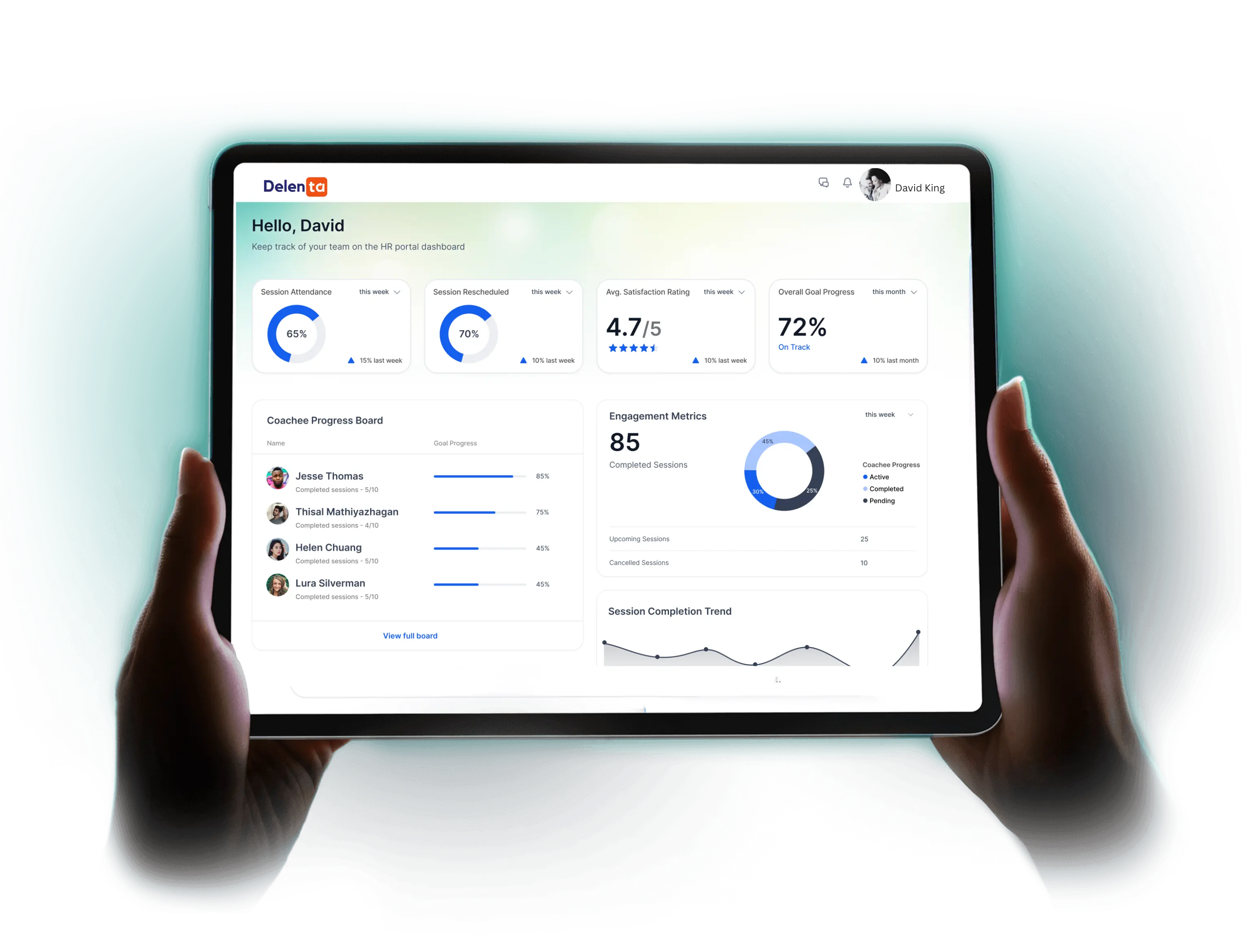
Your coaching platform should make it easier to separate operational reporting from private client content.
Useful capabilities include role-based permissions, account-level reporting, aggregate analytics and clear access controls. Delenta's HR Dashboard and Insights & Reports tools are designed to give administrators visibility into programme activity and outcomes, while permissions can limit what different users can access.
For organisations managing multiple coaches, Delenta Teams centralises coach management, programme delivery and reporting so evidence does not have to be assembled manually across disconnected spreadsheets.
If you are still building reports by combining multiple files, our guide on when a coaching business outgrows spreadsheets explains some of the operational risks that appear as programmes grow.
A sponsor-facing report can stay useful and concise. For example:
That last section matters. Credible impact reporting explains not only the result, but how the result was produced.

Delenta brings coaching delivery and programme reporting into the same operating environment. Teams can manage coaches, clients, sessions, goals and engagement while using reporting and analytics to understand programme activity at scale.
For coaching firms preparing to work with larger organisations, the RFP Readiness Kit also covers the reporting, compliance and technology questions that commonly appear during enterprise procurement.
The objective is not to collect as much coaching data as possible. It is to create a defensible evidence trail while preserving the boundaries that allow clients to coach openly.
You do not have to choose between measurable coaching and confidential coaching.
Define the reporting agreement early. Measure delivery, agreed change and relevant business outcomes. Aggregate wherever possible. Keep private coaching content outside sponsor reporting. And make sure your technology supports the same boundaries your coaching agreement promises.
The strongest coaching ROI report proves enough to build confidence without revealing so much that it damages trust.
Start with the outcomes agreed at the beginning of the programme. Measure delivery and engagement, goal progress, behaviour change and relevant business indicators, then connect those measures to the programme's cost and objectives.
Yes. Most programme evaluation can rely on aggregate engagement data, goal status, pre/post measures, stakeholder feedback and business outcomes without exposing private coaching conversations.
Only information covered by the coaching agreement and appropriate reporting boundaries should be shared. Agree in advance what will be reported, who can see it and how confidentiality will be protected.
No. Small cohorts or highly specific categories can still make individuals identifiable. Use minimum group sizes, broader themes and suppression rules where necessary.
No. A financial ROI percentage is useful only when costs and benefits can be estimated credibly. In many programmes, a combination of engagement, behaviour change and business outcome measures gives a more accurate picture.
A coaching platform can centralise programme activity, coach utilisation, engagement, goals and reporting while using permissions to control access. This reduces manual reporting and makes it easier to keep operational evidence separate from private coaching content.
Want a clearer way to evidence coaching impact at scale? Explore Delenta's HR Dashboard or book a demo to see how coaching delivery and reporting can live in one system.
Choosing a CRM for your coaching business isn't just about managing a contact list; it’s about powering your client’s transformation. While a general CRM focuses on the "Sale," a specialized coaching CRM focuses on the Client Lifecycle, from the first discovery call to the final session and beyond.
The coaching industry is experiencing explosive growth, projected to reach $5.8 billion by 2026 . However, many coaches struggle with administrative overhead, losing an average of 1.25 hours daily on manual tasks like scheduling and invoicing . This guide breaks down the 10 leading platforms to help you decide which engine will power your practice's growth.
Key Takeaways:
A specialized coaching CRM should offer four core pillars: integrated scheduling, automated client onboarding, a secure client portal for resource sharing, and seamless payment processing (Stripe/PayPal). Unlike generic CRMs, coaching-specific tools prioritize the 'coaching journey' over simple sales pipelines