When you run an enterprise coaching programme, you can usually report how many people attended, how many sessions took place and whether participants found the experience useful.
The harder question comes when the sponsor asks: “What did the organisation get back?”
You might have encouraging feedback from managers and stories about better conversations with their teams. Those are worth paying attention to. But they don’t yet explain the programme’s business value or establish a financial return.
For internal coaching leads, HR business partners and learning and development (L&D) teams, this is where evaluation needs to go beyond attendance and satisfaction.
Delenta’s SHADOW framework offers a practical way to approach that work. It connects the changes people notice with organisational data, financial assumptions and a realistic assessment of how much credit coaching deserves. The aim is to build a credible account of value, rather than produce an impressive number that falls apart under scrutiny.

SHADOW is a six-step method for measuring work whose value is real but difficult to see directly.
The idea behind the name is straightforward: even when a change is hard to measure, it can leave signs in things you can observe.
A manager becoming a better listener might be difficult to express in financial terms. Their team, however, can tell you whether one-to-one conversations are becoming more useful. HR data can then help you explore whether relevant business outcomes are improving alongside that change.
The guide draws on the measurement challenge of presenteeism, which is the productivity lost when people work while unwell. It borrows an approach to making less visible value measurable, rather than suggesting that coaching and presenteeism produce the same outcomes.
The six steps are Specify the change, Hear from the witnesses, Anchor a baseline, Do the maths in the open, Offset other causes and Widen the evidence.
SHADOW is intended for coaching, manager-as-coach training, leadership development and wellbeing programmes. It is particularly relevant when the evidence of value tends to arrive as individual stories rather than a structured evaluation.
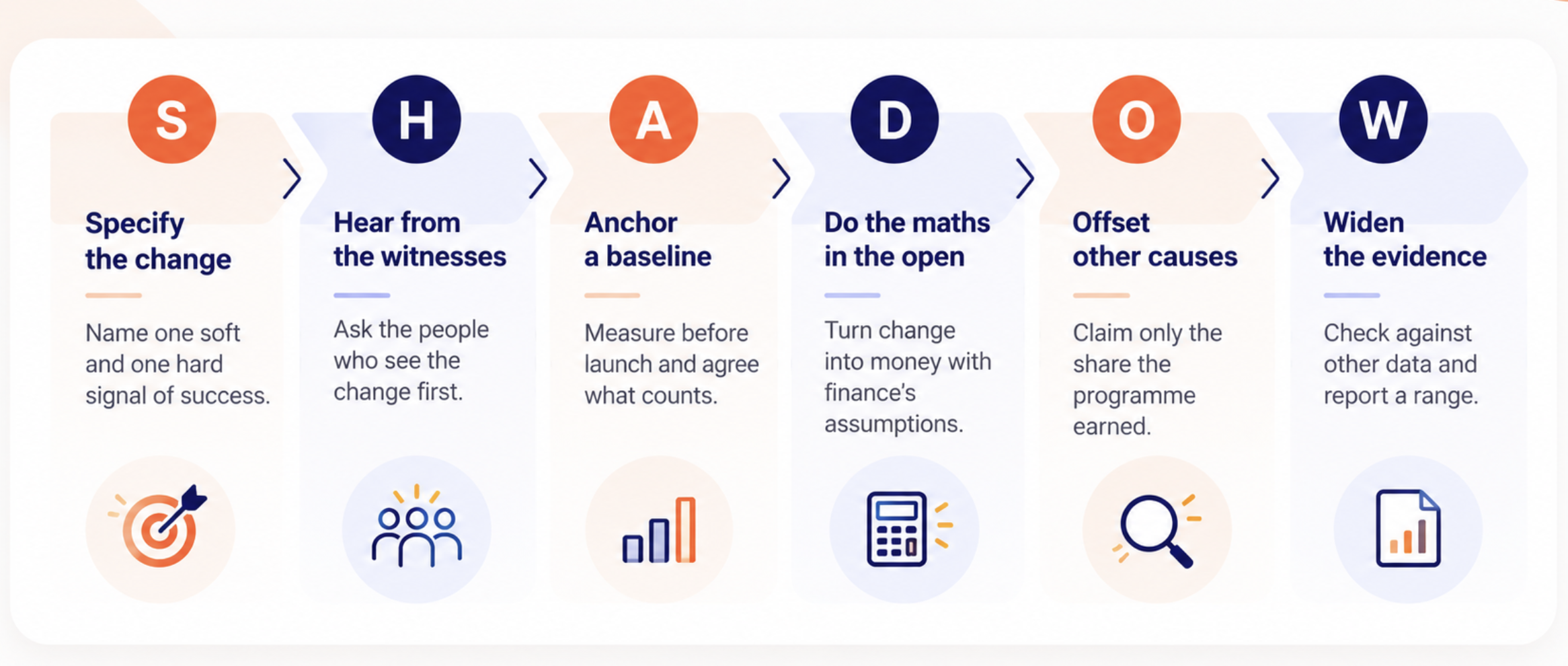
Start by agreeing what the programme should change, not by deciding which data is easiest to collect.
SHADOW recommends choosing one soft and one hard signal of success with the programme sponsor before launch.
The soft signal describes something people can observe in their working experience. The hard signal connects the programme to an organisational outcome.
In the guide’s example, the soft signal is more useful one-to-ones. The hard signal is fewer regretted leavers, meaning employees the organisation wanted to retain.
That gives you a clearer starting point than an ambition such as “develop better leaders”. You have identified an experience that team members can assess and an outcome that HR can track.
A useful question to ask the sponsor is:
What would someone actually see if this programme worked?
Write down the answer and agree the measures before the first session. This gives everyone a shared understanding of what the evaluation will look for.
It does not establish that coaching will cause the desired outcome. That comes later in the assessment.
To understand whether someone’s behaviour has changed, speak to the people who experience it.
For a manager coaching programme, those people will usually be the manager’s team. Their feedback adds something that the coaching participant’s own reflections cannot provide: a view from the other side of the conversation.
In the guide’s one-to-one example, a monthly pulse question could be:
On a scale from 0 to 10, how useful was your most recent one-to-one with your manager?
Keep the wording the same each month so you are tracking a consistent signal.
You don’t need a lengthy survey to get started. You need a question that relates directly to the behaviour the programme is intended to influence.
A manager may feel more confident about their conversations. Team feedback helps you assess whether those conversations are also becoming more useful to others.
Before you can explain what changed, you need to know where things started.
SHADOW recommends collecting three months of readings before the first coaching session, agreeing the measures with the sponsor and identifying a comparison group, such as the next cohort.
The baseline gives you a starting position. The comparison group helps you assess whether similar changes are happening among people who have not yet received the coaching.
Take regretted attrition as an example. A fall after the programme looks encouraging, but its meaning changes if attrition was already falling before launch. It also changes if the same improvement happens in the comparison group.
This is why coaching programme evaluation needs to be part of the planning conversation. By the time the final report is due, the opportunity to collect a reliable baseline has already passed.
Once you have an outcome worth assessing financially, involve finance in the calculation.
SHADOW recommends asking finance for the unit values you need and building the calculation together. For a retention-related outcome, that could be the organisation’s agreed cost of replacing a leaver.
The basic calculation is:
Estimated avoided replacement cost = estimated number of avoided departures × finance-agreed replacement cost
What matters is that someone reading the report can follow the reasoning. They should be able to see which outcome was counted, where the unit cost came from and what assumptions connect the observed change to the estimated value.
Working with finance makes those assumptions a shared responsibility. It also reduces the risk of the coaching team presenting a figure that the organisation does not recognise or accept.
Be careful with the language, too. An estimated avoided replacement cost is not automatically cash released from a budget. Describe the benefit you have estimated, rather than treating every financial value as a direct saving.
Business outcomes can improve during a coaching programme for reasons that have little to do with coaching.
SHADOW asks you to account for that before claiming a return.
Where a comparison group is available, the guide recommends subtracting its change from the change in the coached group.
For example, suppose regretted attrition falls by three percentage points in the coached group and by one percentage point in the comparison group. Under this approach, the additional two-percentage-point improvement is attributed to coaching, rather than the full three points.
Where there is no comparison group, the guide suggests asking people how much of the change they credit to the programme and how sure they are, then taking the lower figure.
This gives you a judgement-based estimate. It does not prove that every other explanation has been ruled out, so make the basis of the estimate clear.
The principle is to claim only the share the programme can reasonably support. A smaller figure with a clear explanation is more credible than a larger one built on assumptions nobody can inspect.
Before drawing a conclusion, check whether other information supports it.
SHADOW recommends looking at engagement, exit interviews and internal mobility alongside your main measures.
In the manager coaching example, team members might report more useful one-to-ones while regretted attrition also falls. Engagement findings and exit interview themes can help you judge whether the wider picture is consistent with that improvement.
The purpose is not to add more metrics to the report. It is to see whether different sources of evidence point towards a similar conclusion.
When they don’t, investigate the difference. Conflicting evidence may reveal something important about where the programme helped, where it did not, or what else was happening.
The guide also recommends reporting a range with the assumptions visible. This is especially important for small cohorts, where the evidence may not support a precise estimate of return.
The worked example on page 3 of the SHADOW guide brings the six steps together.
It describes a six-month coaching programme for 150 first-line managers, costing £300,000. Those managers have 1,200 team members.
These are illustrative figures, not a reported Delenta customer result.
The programme aims to improve the usefulness of one-to-ones and reduce regretted departures. Team members rate their most recent one-to-one each month. The evaluation includes three months of baseline data and a comparison cohort.
Regretted attrition falls from 10% to 7% in the coached group. Finance supplies a replacement cost of £30,000 per leaver.
Here is how the calculation develops:
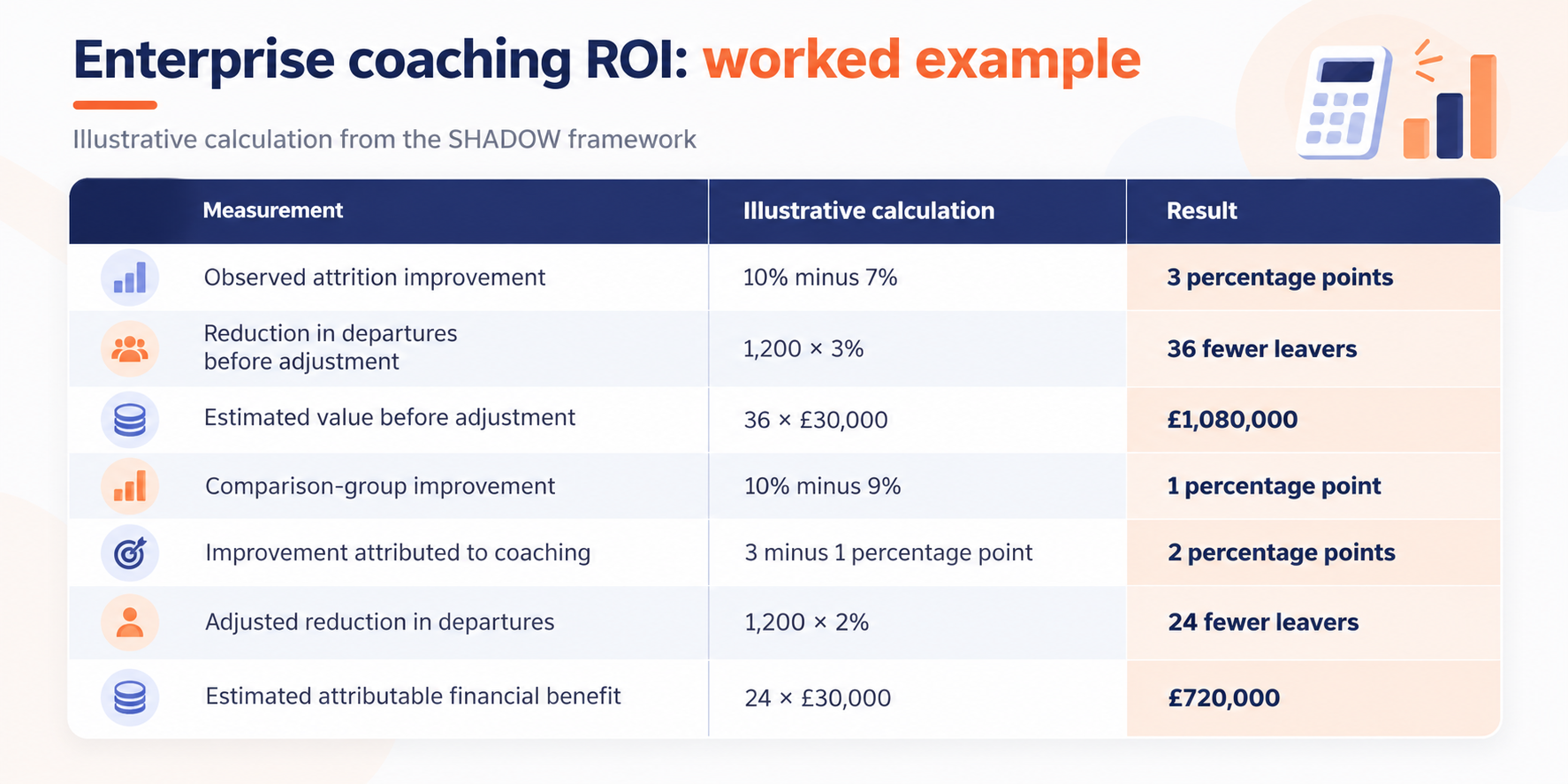
The comparison-group adjustment makes a substantial difference. Rather than claiming the full £1.08 million, the example attributes £720,000 to the programme.
The guide then checks whether pulse scores, exit interviews and engagement move in the same direction. Its final reported value is an illustrative range of £500,000 to £900,000, against the £300,000 programme cost.
The guide does not explain how the endpoints of that range were calculated. It should therefore be treated as an illustrative value range, not a statistical confidence interval.
The £720,000 is an estimated financial benefit attributed to coaching. To calculate net ROI, you also need to subtract the cost of the programme.
Using the figures from the example:
Net ROI (%) = (attributable financial benefit − programme cost) ÷ programme cost × 100
(£720,000 − £300,000) ÷ £300,000 × 100 = 140%
That gives an estimated net benefit of £420,000.
Another way to express the same calculation is £2.40 in estimated benefit for every £1 spent. After accounting for that £1 of programme cost, the estimated net benefit is £1.40.
The 140% figure is an additional calculation using the guide’s illustrative numbers. It is not an ROI percentage reported in the guide, a customer result or a promised return.
When applying this approach to your own programme, make sure the benefits and costs cover a consistent measurement period. Explain how you arrived at any lower and upper estimates rather than copying the range from the example.
The calculation is useful because the reasoning is visible, not because 140% is a target every programme should reach.
SHADOW is designed for the person who owns the programme inside the organisation and needs to account for its budget. That might be an internal coaching lead, a head of L&D or an HR business partner.
That person needs support from colleagues, however.
The sponsor agrees what success should look like. HR provides access to relevant organisational data. Finance supplies the unit values used in the calculation. The programme owner brings those contributions together into a consistent evaluation.
The guide’s planning worksheet gives you a structure for those conversations. It asks what change should be visible, who will notice it, what the baseline is, which assumptions turn change into money, what else could explain the result and which other data should support it.
A practical starting point is to put the agreed answers into one measurement plan before the first coaching session. Record the measures, data sources, responsibilities and assumptions together.
When reporting time comes, you can return to the questions everyone agreed to answer. You are no longer trying to assemble a case from whichever positive stories and figures happen to be available.
Yes. The guide suggests asking people how much of the observed change they attribute to the programme and how confident they are, then taking the lower figure.
Explain how those judgements were collected and make clear that the result is an estimate, not a definitive measure of causation.
The guide allows for small cohorts but cautions that the final range will be wide.
For a small programme, use SHADOW to organise the evidence and explain its limits. Avoid presenting a precise financial return when the available information cannot support one.
Yes. The guide identifies coaching, manager-as-coach training, leadership development and wellbeing work as suitable applications.
In each case, the starting point is the same: agree one soft and one hard signal of success before the programme begins.
You don’t need to reduce every human change to a financial figure to make a credible case for coaching.
You do need to explain what the programme was intended to change, what people observed, how relevant business outcomes moved and how much of that improvement coaching can reasonably claim.
SHADOW gives you a way to work through those questions with the sponsor, HR and finance, rather than leaving the coaching team to answer them alone.
For your next enterprise coaching programme, start with the change that matters to the organisation. Agree how you will recognise it and collect the evidence before the first session takes place.
Based on Delenta’s SHADOW Coaching Intelligence tool guide, adapted from work by Panos Malakoudis. Financial figures come from the guide’s worked example. The net ROI percentage is an additional calculation using those illustrative figures.
Choosing a CRM for your coaching business isn't just about managing a contact list; it’s about powering your client’s transformation. While a general CRM focuses on the "Sale," a specialized coaching CRM focuses on the Client Lifecycle, from the first discovery call to the final session and beyond.
The coaching industry is experiencing explosive growth, projected to reach $5.8 billion by 2026 . However, many coaches struggle with administrative overhead, losing an average of 1.25 hours daily on manual tasks like scheduling and invoicing . This guide breaks down the 10 leading platforms to help you decide which engine will power your practice's growth.
Key Takeaways:
A specialized coaching CRM should offer four core pillars: integrated scheduling, automated client onboarding, a secure client portal for resource sharing, and seamless payment processing (Stripe/PayPal). Unlike generic CRMs, coaching-specific tools prioritize the 'coaching journey' over simple sales pipelines