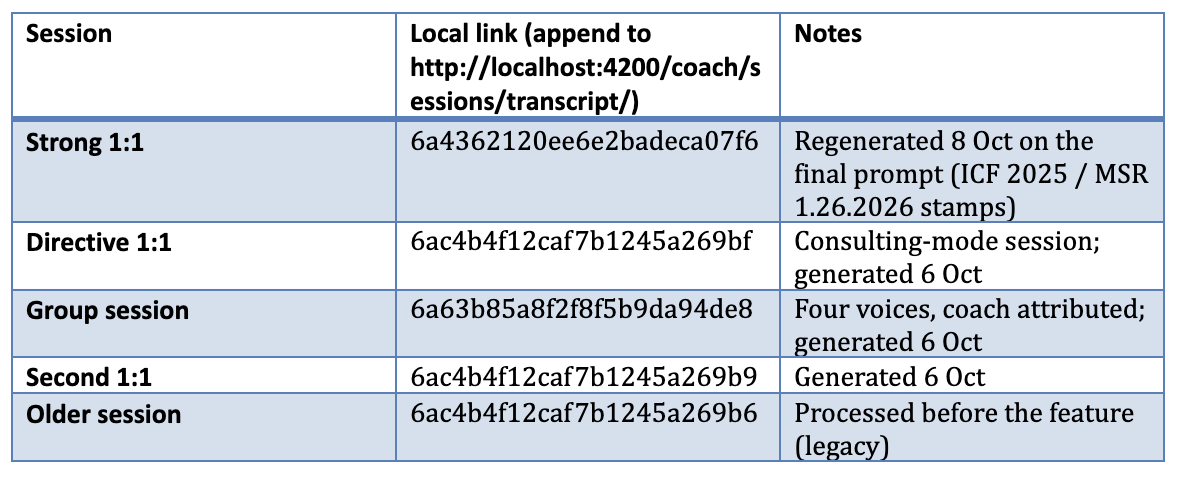
This walkthrough shows the coach-only "Development by ICF level" section on five demo sessions.
Each part quotes the requirement doc "AI Session Notes: ICF developmental insights" (29 September 2026, Proposed) and says how the build meets it, where it deliberately differs, and what is still open.
Sessions belong to the coach Maya Sinclair; client names and transcripts are synthetic test data.
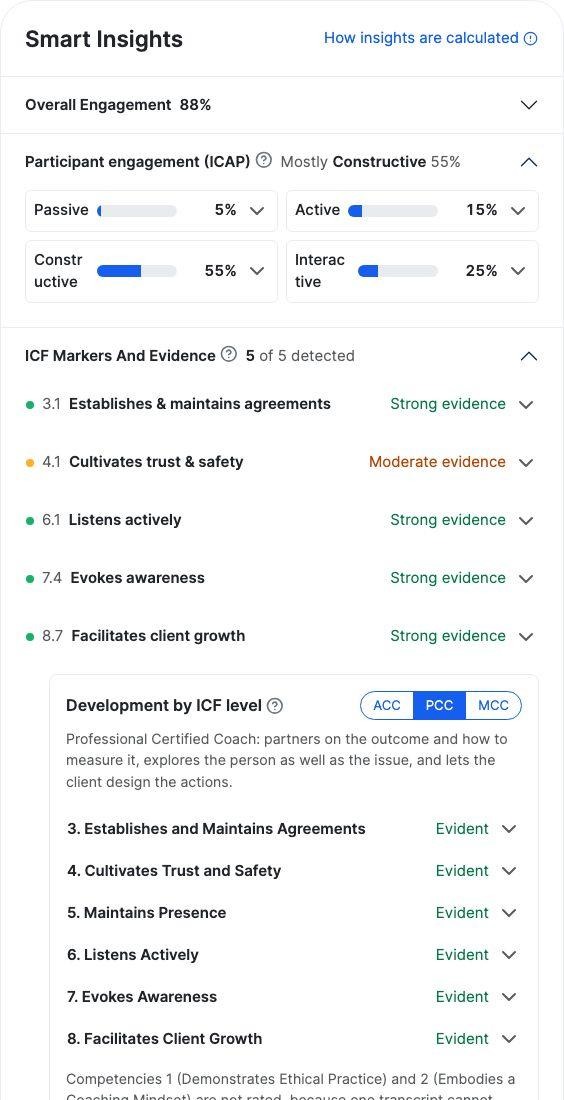
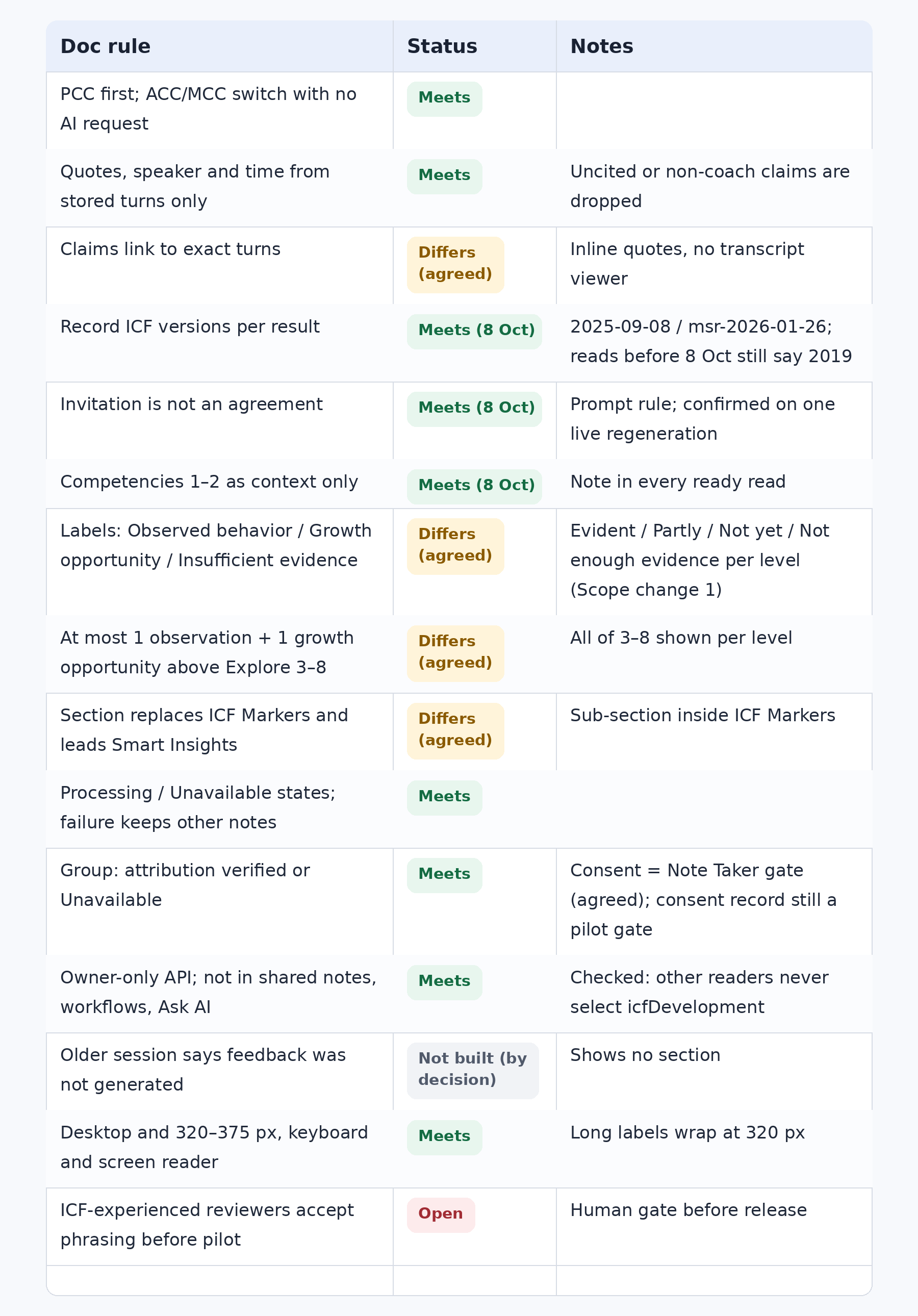
Requirement doc: "Smart Insights leads with ICF developmental insights." "For eligible new sessions, the new developmental view takes the place of the current ICF Markers And Evidence section." "Keep Session Signals collapsed initially."
Built: The section is a sub-section inside ICF Markers And Evidence, after the five marker rows. Overall Engagement starts collapsed, directly above ICAP. The five markers, score, ICAP, WAI, CoI, Session Signals and the ICF disclaimer are unchanged.
Difference from the doc: Deliberate change. After reviewing the first build, the product owner asked for the section to sit inside the ICF section rather than lead the page (Scope change 1, 6 Oct), so it no longer replaces the markers.
Strong 1:1 after Show Smart Insights: Overall Engagement collapsed, ICAP, the five ICF markers, then Development by ICF level.
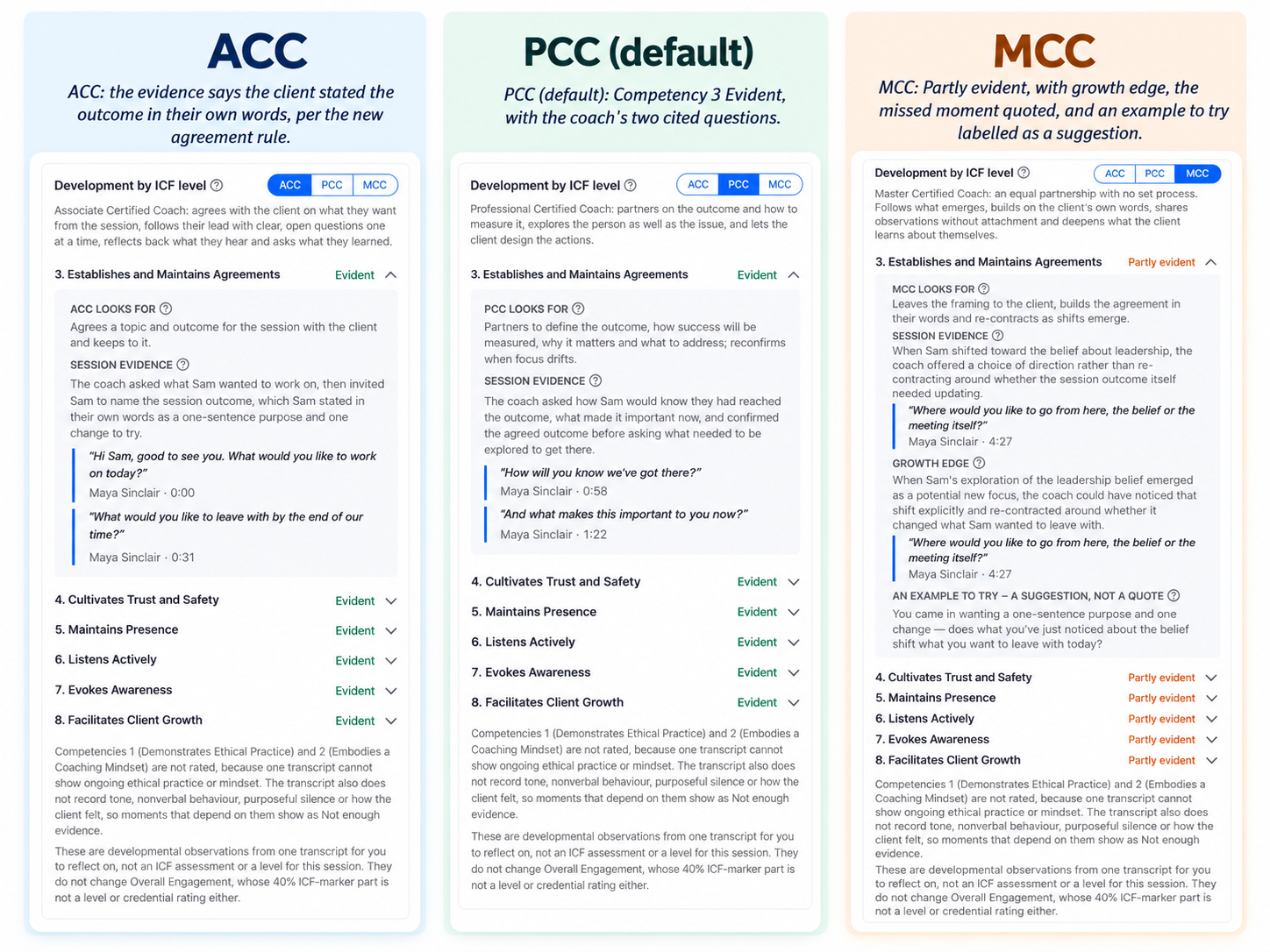
Requirement doc: "PCC is selected on first view; ACC and MCC are selectable." "Use the same fixed transcript and verified coach observations for all three lenses. Lenses may select different verified turns; switching makes no AI request."
Built: PCC is selected by default. All three lenses come from one stored read, so switching is instant and sends no request. Each level has its own "looks for" text, evidence, growth edge and example to try, and a level is never rated above the one below it.
The three shots below are Competency 3 (Establishes and Maintains Agreements) on the strong 1:1 at each lens. At ACC and PCC the coach meets the level; at MCC it is Partly evident, with a growth edge about re-contracting when the client's focus shifted.
Requirement doc: "Every behavioral claim names the coach action, states the level-specific interpretation, and links to the exact authorized transcript turn(s)." "Resolve displayed quote, speaker and time from a retained structured turn source, never from model-written free text."
Built: Every quote, speaker and m:ss is filled in by the server from the stored transcript turns. A claim citing any id that is not a coach turn is dropped. Citations are shown inline rather than as links into a transcript viewer (agreed scope; there is no in-app viewer).
Requirement doc: "A single invitation to agree is not described as a completed agreement." "A coach question alone is rarely enough to establish a mutual agreement or client learning."
Built (added 8 Oct): The prompt now says a coach question or invitation about what the client wants is not, by itself, an agreement. An agreement is described as reached only when the client states the outcome in their own words or confirms the coach's wording. On the regenerated strong 1:1, the ACC evidence reads "...invited Sam to name the session outcome, which Sam stated in their own words".
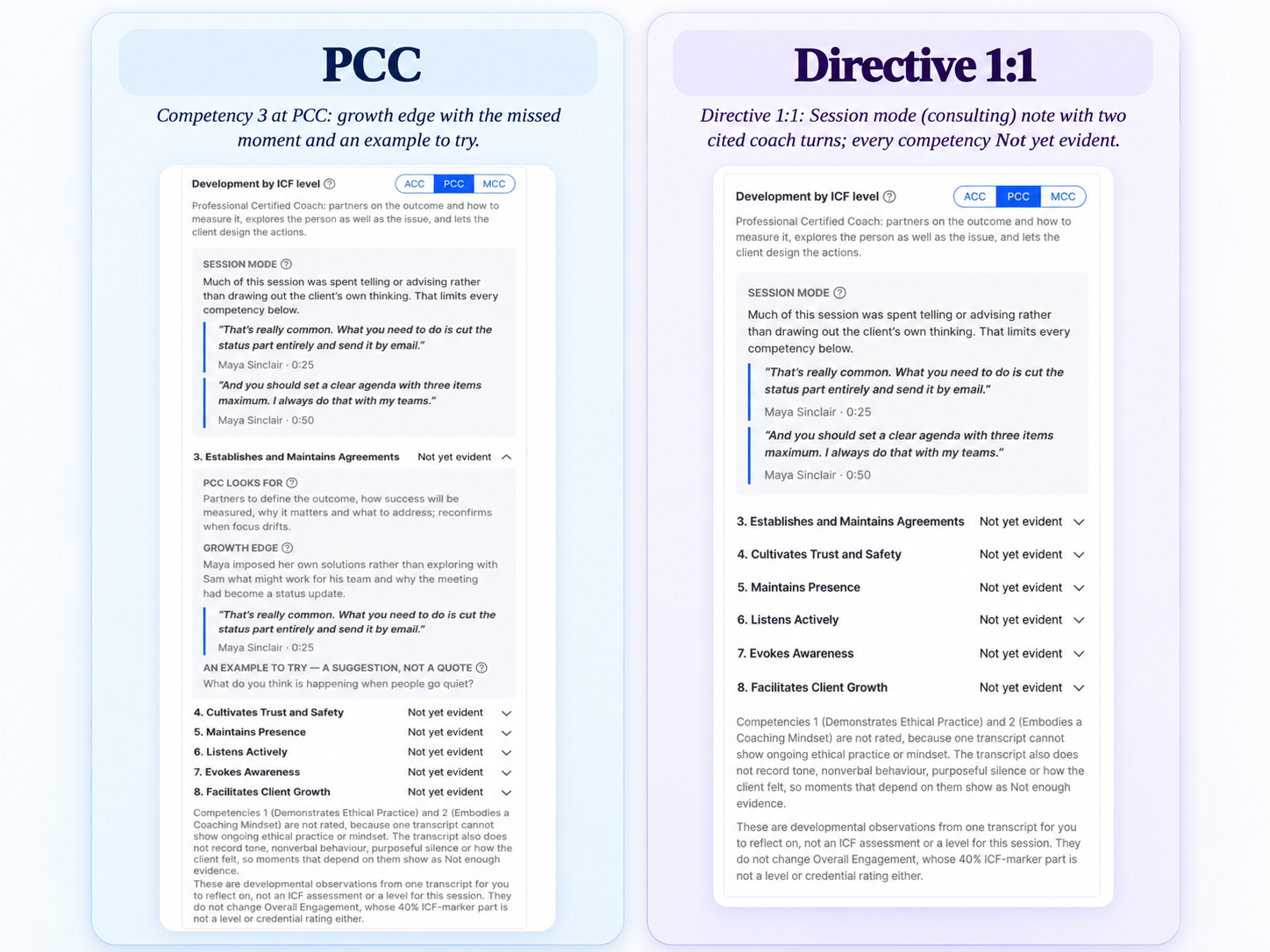
Requirement doc: "Describe observable behavior and a plausible developmental opportunity. Do not award a level, score a competency, predict a pass/fail outcome, claim ICF endorsement or infer client experience from silence." "Missing or ambiguous evidence is Insufficient evidence, never poor coaching."
Built: When a session is mostly telling or advising, a Session mode note with the coach's own quotes appears above the rows and caps every competency at Not yet evident. Session evidence is not shown; the growth edge quotes the missed moment and gives an example question to try.
Open item: This read was generated on 6 Oct, before the latest prompt fixes. Its Competency 3 growth edge says "Maya imposed her own solutions", which names the person rather than describing the coach's behaviour as the prompt asks. Worth regenerating and checking during the ICF reviewer pass.
Requirement doc: "Evaluate the coach's facilitation, attribute each cited voice, and make only claims supported by those exchanges. Suppress new feedback if consent, coach attribution or evidence cannot be verified." "No one participant's response may be presented as the whole group's outcome."
Built: Only coach turns are cited, each with the coach's name and time. If the coach speaker cannot be matched, the section shows Unavailable and every other insight stays. The Note Taker setting is treated as group consent (agreed scope); the doc's "authoritative group consent record" is still a pilot gate.
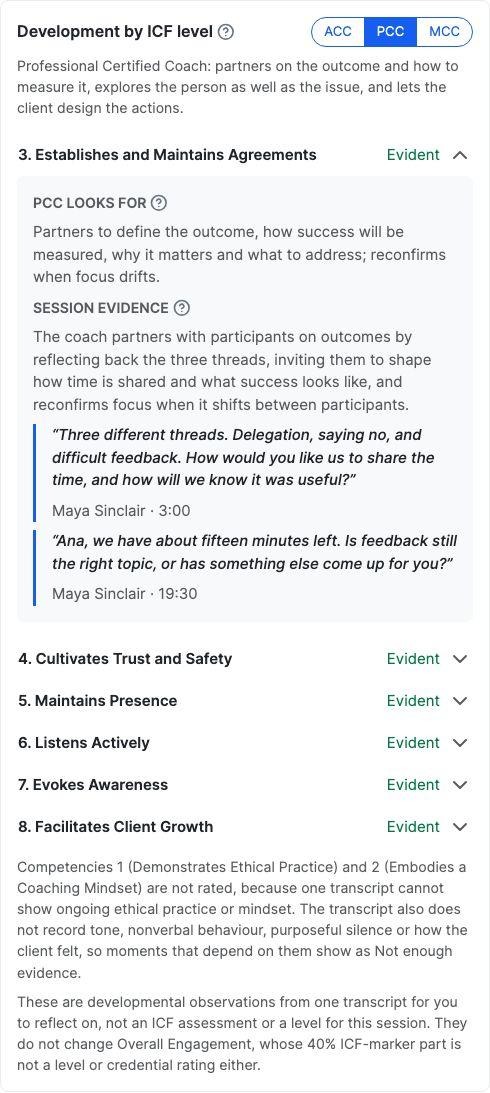
Group session, Competency 3 at PCC: the coach shares time across three threads and reconfirms focus with one participant.
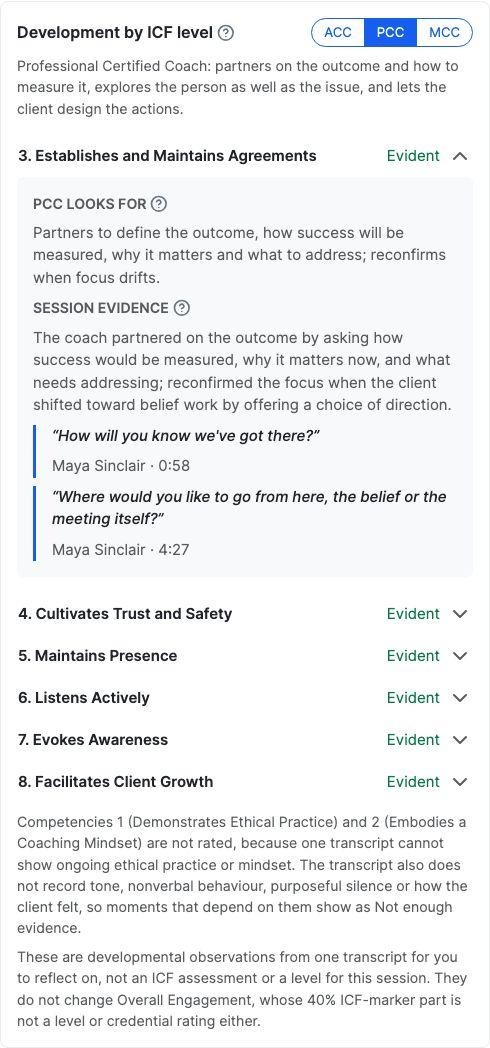
Another 1:1 read at PCC, Competency 3 expanded.
Requirement doc: "Show Competencies 1 Demonstrates Ethical Practice and 2 Embodies a Coaching Mindset only as context and limitations. One text transcript cannot establish ongoing ethics or mindset, felt trust, nonverbal behavior, tone or purposeful silence."
Built (added 8 Oct): Every ready read ends with a note that Competencies 1 and 2 are not rated, because one transcript cannot show ongoing ethical practice or mindset, and that tone, nonverbal behaviour, purposeful silence and how the client felt are not recorded, so moments that depend on them show as Not enough evidence. It is visible at the bottom of every section screenshot above. The footer keeps saying this is not an ICF assessment and that the 40% ICF-marker part of Overall Engagement is not a level or credential rating.
Requirement doc: "Older session: Existing notes and signals remain. State says level feedback was not generated for this session. No automatic backfill."
Built: An older session shows its five ICF markers and existing insights exactly as before, with no new section and no backfill.
Difference from the doc: There is no "level feedback was not generated" line; that was left out of this release by decision.
Older session: ICF Markers And Evidence unchanged, no developmental section.
Choosing a CRM for your coaching business isn't just about managing a contact list; it’s about powering your client’s transformation. While a general CRM focuses on the "Sale," a specialized coaching CRM focuses on the Client Lifecycle, from the first discovery call to the final session and beyond.
The coaching industry is experiencing explosive growth, projected to reach $5.8 billion by 2026 . However, many coaches struggle with administrative overhead, losing an average of 1.25 hours daily on manual tasks like scheduling and invoicing . This guide breaks down the 10 leading platforms to help you decide which engine will power your practice's growth.
Key Takeaways:
A specialized coaching CRM should offer four core pillars: integrated scheduling, automated client onboarding, a secure client portal for resource sharing, and seamless payment processing (Stripe/PayPal). Unlike generic CRMs, coaching-specific tools prioritize the 'coaching journey' over simple sales pipelines