Growth is usually what coaches work toward. More clients, fuller programmes, stronger referrals and perhaps another coach joining the business can all be signs that the practice is working.
But growth introduces a real tension: the systems that make a coaching practice easier to run can also make clients feel like they are moving through a process rather than being supported by a person.
The answer is not to avoid systems. It is to be selective about what you systemise. Scale the workflow around coaching, not the relationship at the heart of it.
When a practice is small, personalisation happens almost automatically. You remember every client’s context, you know when they prefer to meet, you can find their latest goal quickly and you handle most follow-up yourself.
As the client base grows, that approach becomes harder to sustain. More information lives in your head. More bookings need coordinating. More follow-ups compete for attention. If a team is involved, the challenge grows again because the client experience now depends on more than one person.
This is where coaches often make one of two mistakes. They either keep doing everything manually until the business becomes exhausting, or they automate so much that the experience starts to feel generic.
A better approach is to protect the moments where human attention matters most, then build reliable systems around them.
Start by dividing your client experience into two categories.
Logistical work includes tasks such as scheduling, reminders, forms, payment administration, session links and giving clients access to resources.
Relational work includes listening, noticing patterns, remembering context, adapting your questions, checking in when something matters and making judgement calls about what a client needs.
Logistics are usually good candidates for systems and automation. Relational work is where the coach should stay visible.
For example, an automated reminder before a session is useful because the client simply needs the correct time and link. An automated “personal” message after a difficult coaching conversation may feel very different. That moment may deserve a short note written by you.
This distinction gives you a simple rule for scaling: automate predictability; protect judgement.
Consistency does not have to mean sameness.
A scalable coaching practice needs a repeatable client journey: what happens after a discovery call, how a client signs an agreement, how they pay, where they complete an intake form, how sessions are booked and how progress is reviewed.
That framework should be consistent because it removes uncertainty for both you and the client. What happens inside the framework can still be personal.
Imagine two leadership coaching clients entering the same six-month programme. They can receive the same clear onboarding sequence while having completely different goals, session focus, resources and follow-up actions. The system is standardised. The coaching is not.
This also makes growth easier to manage because you are no longer rebuilding the operational process every time a new client joins.
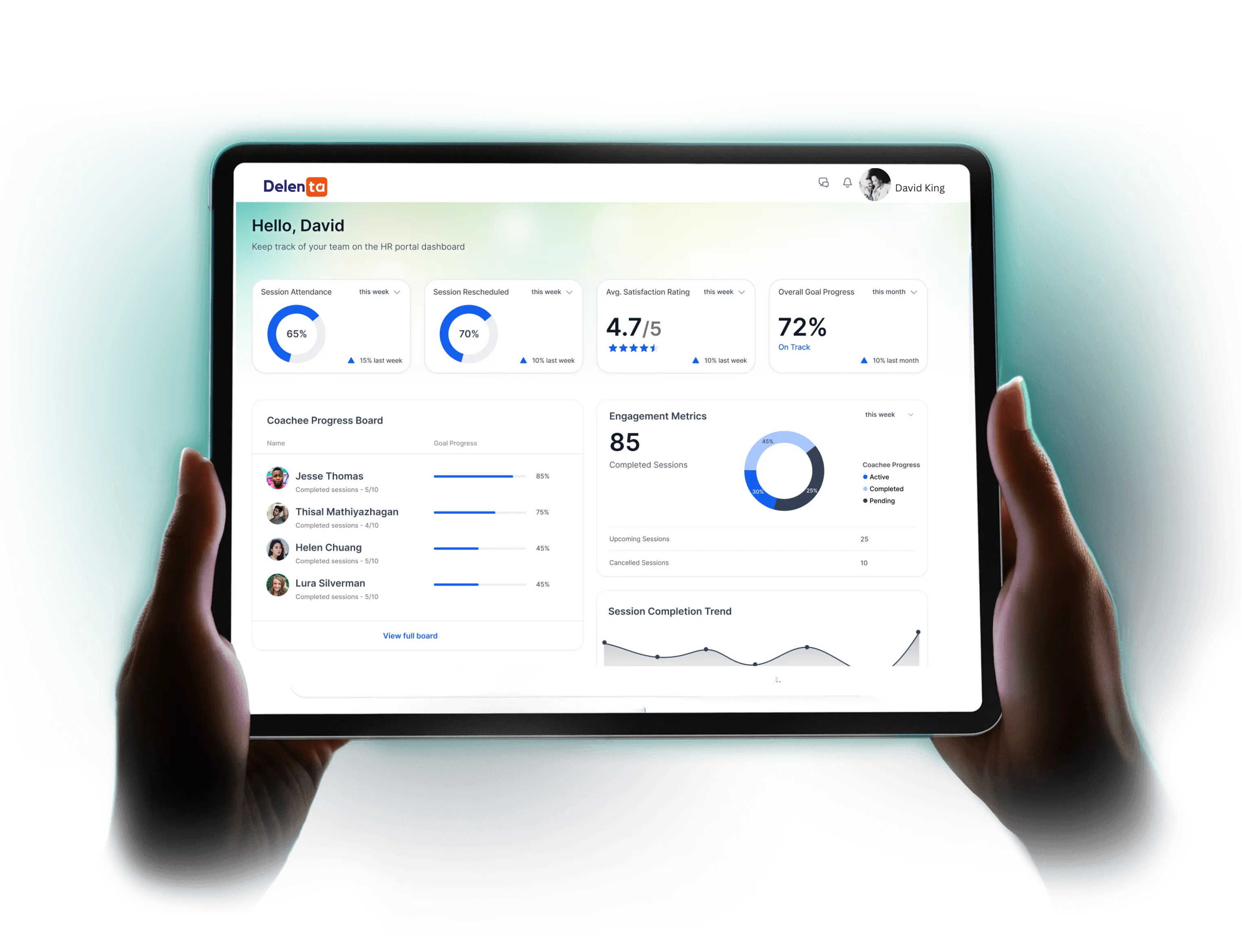
One of the fastest ways to make growth feel impersonal is to scatter the client experience across too many places.
If a client has to search email for a resource, check another app for a meeting link, message you for an invoice and look somewhere else for a goal, the experience feels fragmented even when the coaching itself is excellent.
A client portal can give the relationship a clear home. Clients know where to return for sessions, resources, goals and other relevant information, while you reduce the number of repetitive questions you need to answer.
Delenta’s client portal is designed to keep key parts of the coaching relationship connected in one place.
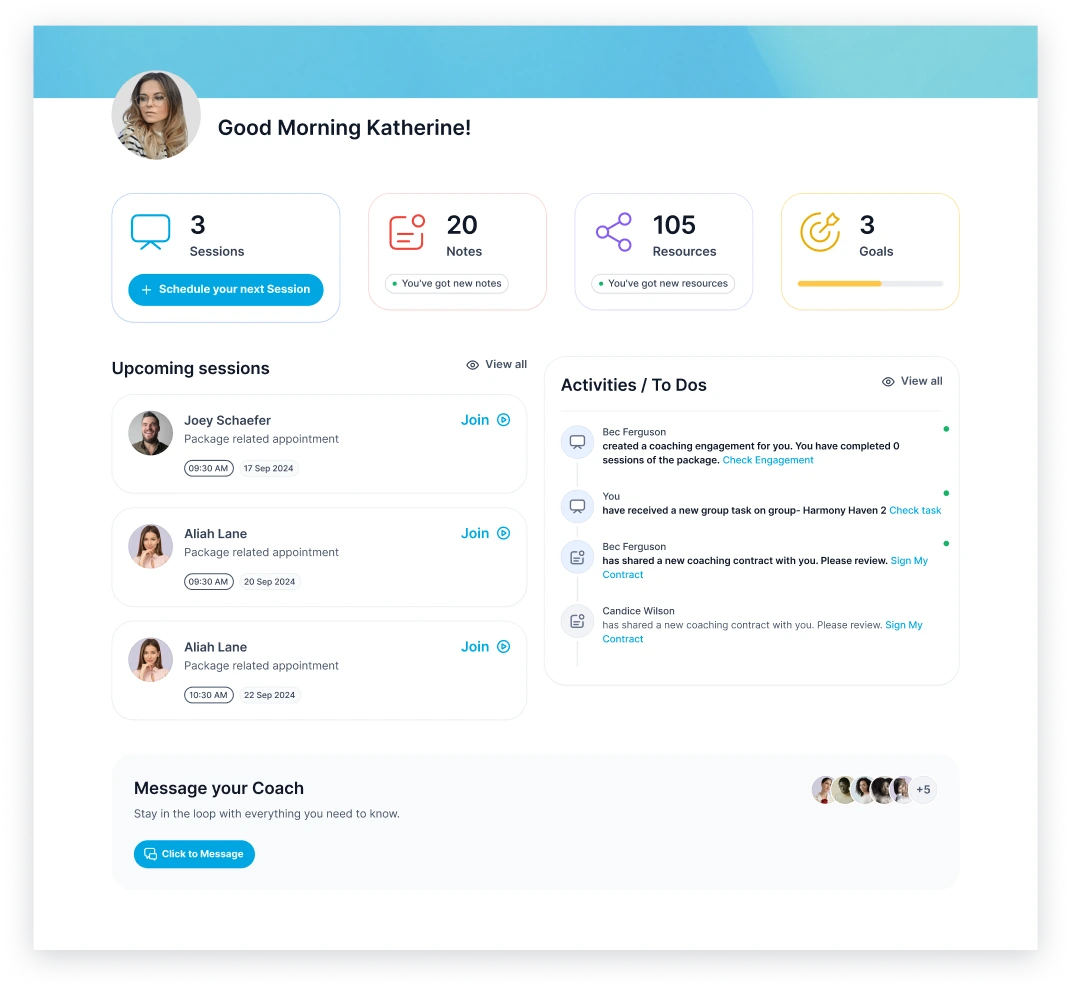
The point is not to make clients “self-service” so you can disappear. It is to remove avoidable friction so your personal attention is available for the things that need it.
Back-and-forth scheduling feels manageable with five clients. With twenty, thirty or a growing team, it can become a large amount of invisible work.
Self-scheduling, calendar availability, confirmations and reminders are examples of automation that clients often experience as helpful rather than impersonal. They create clarity and reduce waiting.
You still decide when you are available, how long sessions should be and what boundaries protect your coaching time. The technology handles the coordination.
See how coaching scheduling with Delenta can support a more structured booking process.
Personal coaching depends on context. A client notices when you remember what mattered last time, the commitment they made and the pattern they have been working through.
As a practice grows, memory is no longer a reliable operating system.
Keep notes, goals, actions, forms and relevant client history connected so you can review the right context before a session. A coaching CRM can make this easier by giving you a central client record instead of asking you to reconstruct the relationship from email, spreadsheets and separate documents.
Explore Delenta’s coaching CRM for a more centralised way to manage client information and coaching workflows.
This is a good example of technology increasing personalisation rather than reducing it. The system remembers the detail so the coach can focus on the person.
When you are small, warm moments happen spontaneously. When you scale, they are easier to lose unless you intentionally make space for them.
Choose a few moments in the client journey where you want the human connection to be especially visible. For example:
These moments do not need to be long. They need to feel real.
Scaling is not always about taking on more one-to-one clients yourself. At some point, growth may involve group coaching, programmes, courses or additional coaches.
The same principle still applies: create a consistent operating structure while allowing the coaching experience to respond to the individual.
If you add coaches, define what should be consistent across the business: onboarding, communication standards, record keeping, scheduling, progress tracking and the overall client journey. Then leave space for each coach’s professional style and the needs of each client.
Delenta supports multi-coach teams and group coaching so growing coaching businesses can coordinate delivery without managing every workflow manually.

When deciding what to systemise, use this four-part map:
If an activity requires empathy, interpretation or knowledge of the person, keep a human close to it. If it is repetitive, predictable and administrative, look for a better system.
Do not judge a scaling system only by how much time it saves you. Also ask whether it improves the client experience.
Useful questions include:
If the business is easier to run but the relationship feels colder, the system needs adjusting.
Delenta brings client management, scheduling, notes, goals, forms, resources, packages, payments, client portals, team management and reporting into one coaching platform.
For a growing practice, the value is not “more software.” It is having fewer disconnected workflows competing for your attention.
That gives you more room to do the part clients cannot automate: listen, challenge, notice, adapt and coach.
You do not have to choose between growth and personal service.
A scalable coaching practice is not one where every interaction is automated. It is one where the repeatable work is structured well enough that the human work can stay human.
Build systems around scheduling, administration and information. Keep personal attention around context, judgement and connection. That is how you increase capacity without making clients feel like a number.
Standardise the operational parts of the client journey, centralise client context and automate repetitive logistics. Keep coaching conversations, feedback and meaningful check-ins personal.
Start with predictable administrative work such as scheduling, reminders, forms and routine payment or onboarding steps. Avoid automating moments that depend on judgement or empathy simply because they are time-consuming.
Not when it is used well. A portal can reduce friction by giving clients one reliable place for information, while personal communication and coaching remain human.
No. Scaling may involve better systems, group coaching, courses, packages or a team. The right path depends on your offer, capacity and the experience you want clients to have.
Define shared standards for onboarding, communication, scheduling, records and progress tracking, while allowing coaches to adapt their coaching to each client.
Ready to grow without adding more operational noise? Start a free trial of Delenta and build a coaching workflow that gives you more capacity while keeping clients at the centre.
Choosing a CRM for your coaching business isn't just about managing a contact list; it’s about powering your client’s transformation. While a general CRM focuses on the "Sale," a specialized coaching CRM focuses on the Client Lifecycle, from the first discovery call to the final session and beyond.
The coaching industry is experiencing explosive growth, projected to reach $5.8 billion by 2026 . However, many coaches struggle with administrative overhead, losing an average of 1.25 hours daily on manual tasks like scheduling and invoicing . This guide breaks down the 10 leading platforms to help you decide which engine will power your practice's growth.
Key Takeaways:
A specialized coaching CRM should offer four core pillars: integrated scheduling, automated client onboarding, a secure client portal for resource sharing, and seamless payment processing (Stripe/PayPal). Unlike generic CRMs, coaching-specific tools prioritize the 'coaching journey' over simple sales pipelines