AI in coaching is most useful when it reduces administrative friction and gives the coach better information—not when it tries to replace the coach's judgement, presence or relationship with the client. A practical rule is to automate predictable, reviewable work and keep responsibility for meaning, ethics and human decisions with the coach.
That sounds simple, but the line is becoming harder to see. AI can now transcribe conversations, summarise sessions, identify themes, draft follow-ups, organise actions and analyse patterns. For coaching organisations, the question is no longer whether AI will be present in the workflow. It is where AI genuinely improves the work and where it introduces risk or weakens the relationship.
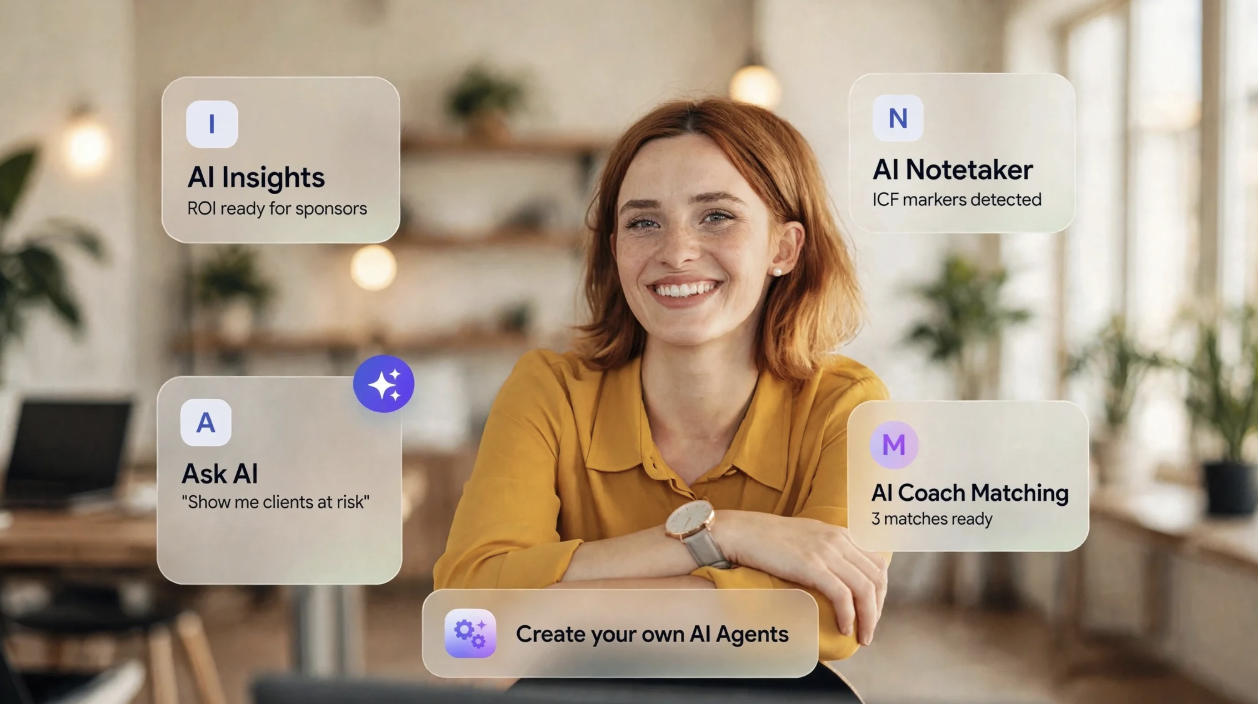
Use AI first for work that is repetitive, time-consuming, rules-based or easy for a human to verify. The closer a task gets to confidential interpretation, ethical judgement or a high-stakes client decision, the more important human ownership becomes.
The ICF AI Coaching Framework and Standards treats AI as something that can complement coaching while requiring attention to ethics, privacy, bias, testing and the coaching relationship.
This is the lowest-risk place to begin because the work is predictable.
Most of this does not even require generative AI. Traditional automation is often the better tool when the workflow follows clear rules.
Delenta's coaching scheduling tools automate bookings and calendar workflows, while the wider platform connects these operational steps to the client record.

Trying to listen deeply while capturing detailed notes can split a coach's attention. AI can help by processing a session transcript and producing a draft summary or action list for the coach to review.
Delenta's AI Notetaker supports post-session summaries and transcript-based outputs for supported video workflows. The important word is draft.
The coach should still decide:
AI can reduce note-taking effort. It should not quietly become the final authority on what happened in a coaching conversation.
AI is good at helping structure information. It can cluster themes, turn agreed actions into a cleaner list, identify repeated topics or help a coach retrieve information from a larger body of notes.
That can be useful when a coach is preparing for the next session or when a programme administrator is looking at aggregate activity.
But organisation is different from interpretation.
A system might detect that the word “confidence” appears repeatedly. The coach understands whether that reflects a development goal, a protective story, a cultural context, a temporary situation or something else entirely.
Let AI find patterns. Let the coach decide what the patterns mean.
For coaching organisations, reporting can involve a large amount of manual work: consolidating session activity, programme engagement, goal status and other operational data.
AI can assist with organising or summarising appropriate programme-level information, while dashboards and analytics can reduce the need to build every report by hand.
Delenta's HR Dashboard and reporting capabilities help coaching organisations monitor programme activity and outcomes. When AI is involved, confidential client content should still be separated from the reporting layer unless there is a clear and agreed basis for sharing it.
For a practical framework for translating coaching outcomes into sponsor-ready evidence, see Delenta's SHADOW Coaching Intelligence guide.
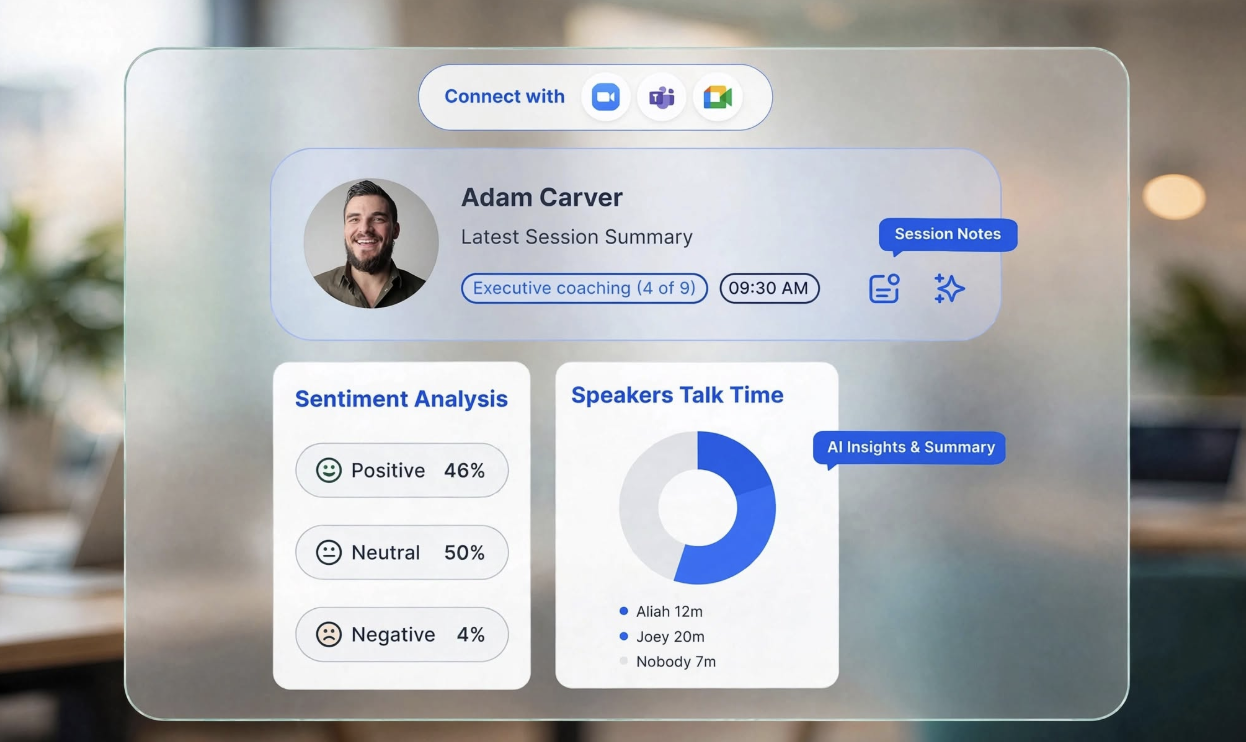
Conversation analytics can give coaches another lens on their practice. For example, a system may surface speaking patterns, question types, conversational markers or areas worth reviewing.
That can be useful as reflective evidence, particularly when the coach treats it as a prompt for learning rather than a definitive judgement.
Delenta's AI Notetaker includes coaching-focused conversational analytics and ICF-related markers. These can support reflection, but professional development still needs context, supervision, mentor coaching and human interpretation.
A metric can start a question. It should not end the question.
Some tasks may be AI-assisted, but the responsibility should remain human.
Presence, trust, curiosity and psychological safety are not administrative outputs. They are created through the relationship between coach and client.
An AI tool may produce a suggested question. It cannot take responsibility for whether that question is right for this person, at this moment, in this context.
A coach continually makes choices about when to challenge, when to stay with silence, when to explore, when to contract again and when a situation sits outside the scope of coaching.
Those are not simply language-generation tasks. They involve professional judgement and responsibility.
The ICF Code of Ethics makes coaches responsible for their ethical and legal obligations when using technology systems, including AI.
That means the coach cannot outsource questions such as:
A vendor can provide controls. The coach still owns the professional decision.
AI can summarise what was said. Coaching often depends on what the client makes of what was said.
Meaning is shaped by context, identity, emotion, timing, values and the client's own interpretation. The coach's role is not to impose an AI-generated explanation but to support the client in thinking, noticing and choosing.
A difficult observation can be transformational when it comes from a trusted coach who understands the relationship and can respond to what happens next.
Automatically generated feedback can miss tone, timing and context. Use AI to prepare, organise or suggest possibilities if helpful, but let the coach decide whether and how a challenge should be offered.
If a client presents a situation involving risk, mental-health needs outside the coach's competence, legal concerns or another high-stakes issue, the decision should not be delegated to an AI assistant.
Technology may surface information. The coach must apply the relevant professional, organisational and legal process.
A useful distinction is to ask two questions.
Can AI do part of this task? Often, yes.
Can AI own the consequences of this task? Usually, no.
That leads to a practical model:
Before automating a workflow, score it informally against four questions.
A public marketing draft is different from a transcript containing a client's personal disclosures.
A booking reminder is easy to check. An interpretation of a client's emotional state is not.
A typo in an internal summary has a different consequence from an incorrect risk assessment or an inappropriate message sent to a client.
If the value of the task depends on trust, nuance, empathy or professional judgement, keep the human closer to the decision.
The higher the sensitivity, ambiguity, consequence or relational importance, the stronger the case for human control.
One of the easiest mistakes is adding AI to a workflow simply because AI is available.
If the system only needs to send a reminder 24 hours before a session, a deterministic rule is more reliable than asking a language model to decide when and what to send.
Use the simplest technology that solves the problem:
This approach is usually easier to govern and easier to explain to clients.
If AI processes coaching conversations, clients should understand what technology is being used and what happens to their information.
ICF's current ethics guidance emphasises informed consent and the coach's responsibility to understand the technology systems used in coaching.
Before using an AI notetaker or similar tool, be able to explain:
The exact requirements will depend on your professional obligations, contracts and jurisdiction, but transparency is a good starting point.
A solo coach can make an individual decision about a tool. A coaching organisation may have dozens or hundreds of coaches making those decisions.
That creates the need for platform-level governance.
For multi-coach teams, useful controls include:
Delenta allows team administrators to manage AI availability centrally and control specific AI features across a team. That type of governance helps organisations adopt AI consistently rather than leaving every coach to create a separate policy.
For broader team operations, see Delenta Teams.
Delenta-i is designed around a “stay human while AI handles the rest” approach: use intelligence and automation to reduce operational work and create better visibility while keeping the coaching relationship at the centre.
That direction is consistent with a broader principle for coaching technology: the best AI does not make the coach less important. It gives the coach more space to do the parts of the work that require a coach.
If you are building your wider automation stack as a solo practitioner, our guide to what a solo coach should actually automate provides a useful companion framework.
The right question is not “How much coaching can we automate?”
It is “Which parts of the workflow can technology handle so the coach can be more present, thoughtful and effective?”
Automate predictable administration. Let AI assist with transcripts, draft summaries, organisation, reporting support and reflective analytics. Keep interpretation, ethics, confidentiality, challenge, safeguarding and the coaching relationship under human ownership.
Use AI to extend the coach's capacity, not to dilute the coach's responsibility.
AI can support coaching workflows through transcription, session-summary drafts, information organisation, pattern detection, administrative automation, reporting support and reflective analytics.
They can be useful when they reduce divided attention during sessions, but coaches should consider informed consent, confidentiality, data handling, accuracy and human review before relying on AI-generated notes.
AI can perform or assist with parts of a coaching workflow, but professional judgement, ethical accountability, relationship, meaning-making and nuanced challenge remain human responsibilities in professional coaching.
Start with low-risk, repetitive administration such as scheduling, reminders, intake workflows and routine communications. Then consider AI assistance for reviewable tasks such as transcription and draft summaries.
Coaches should retain ownership of ethical decisions, confidentiality choices, high-stakes interpretations, safeguarding and referral decisions, contracting, professional judgement and the final use of AI-generated client information.
Create an approved-tool policy, define consent and data rules, use role-based access, control AI features centrally where possible, train coaches on review requirements and document which decisions always require human ownership.
Want to see what human-centred AI can look like inside a coaching workflow? Explore Delenta-i or book a demo.
Choosing a CRM for your coaching business isn't just about managing a contact list; it’s about powering your client’s transformation. While a general CRM focuses on the "Sale," a specialized coaching CRM focuses on the Client Lifecycle, from the first discovery call to the final session and beyond.
The coaching industry is experiencing explosive growth, projected to reach $5.8 billion by 2026 . However, many coaches struggle with administrative overhead, losing an average of 1.25 hours daily on manual tasks like scheduling and invoicing . This guide breaks down the 10 leading platforms to help you decide which engine will power your practice's growth.
Key Takeaways:
A specialized coaching CRM should offer four core pillars: integrated scheduling, automated client onboarding, a secure client portal for resource sharing, and seamless payment processing (Stripe/PayPal). Unlike generic CRMs, coaching-specific tools prioritize the 'coaching journey' over simple sales pipelines